


Choosing the right niche is the single most important decision you’ll make in affiliate marketing. Get it right, and everything downstream — your content, your traffic, your conversions, your income — becomes dramatically easier. Get it wrong, and you can spend months writing content that nobody reads and promoting products that nobody buys.
Most beginners rush past this step. They see a friend succeeding in the fitness niche, or read that “finance pays well,” and jump in without ever checking whether that niche fits their own skills, interests, or realistic ability to compete. A few months later, they’re stuck — no traffic, no sales, and no clear idea why.
This guide will walk you through exactly how to choose a profitable affiliate marketing niche in 2026, using a proven, step-by-step process. We’ll also break down which niches currently convert the best, based on the latest available data, so you’re not guessing — you’re choosing with evidence behind you. Along the way, we’ll cover the evaluation criteria that matter most, realistic timelines by niche type, the mistakes that quietly sink otherwise good niche ideas, and the tools that make validation fast and reliable.
By the end of this article, you’ll know exactly how to evaluate, narrow down, and confidently commit to a niche that fits both your interests and your income goals — and you’ll have a repeatable framework you can use again any time you want to expand into a new niche later.
Why Niche Selection Matters So Much
Many beginners treat niche selection as a minor first step — something to get out of the way quickly so they can start “the real work” of writing content and promoting links. This is a mistake, and it’s one of the biggest reasons new affiliate marketers give up within their first year. Your niche shapes almost every decision you’ll make afterward, often in ways that aren’t obvious until months later.
- It determines your audience. A narrow, well-defined niche attracts a specific type of reader who is actively looking for a solution — and specific, high-intent readers convert far better than a general audience. A visitor searching for “best budgeting app for freelance graphic designers” is far more likely to buy than someone who searched “personal finance tips.”
- It determines your income ceiling. Some niches simply pay more per sale or offer recurring commissions that compound month after month, while others cap out at small one-time payouts of a few dollars per sale. The niche you choose sets the mathematical boundaries of how much you can realistically earn, no matter how good your content is.
- It determines your competition level. Broad, popular niches are often saturated with established sites, large media companies, and years-old domains that are difficult to outrank. Narrower niches can offer a faster, more realistic path to visibility, especially for a brand-new website with no existing authority.
- It determines your content difficulty. Some niches require you to be a certified expert (like medical or legal advice) to be trusted by both readers and search engines; others are far more approachable for beginners without any formal credentials.
- It determines your long-term motivation. If you pick a niche purely because it’s profitable but you have zero interest in it, burnout tends to happen fast — usually right around the point where results would otherwise start to show up. Passion and profitability need to intersect for the business to survive long enough to succeed.
Because your niche influences so much of what comes after, it’s worth slowing down here rather than rushing into it. Think of niche selection as laying a foundation — every article, every video, every email you send later will be built on top of this one decision.
New to affiliate marketing? Start with our beginner-friendly guide and learn the exact steps to build your first affiliate income online.https://ezmakaffiliates.com/affiliate-marketing-for-beginners-how-to-start/
How to Evaluate a Potential Niche: The 5 Key Criteria
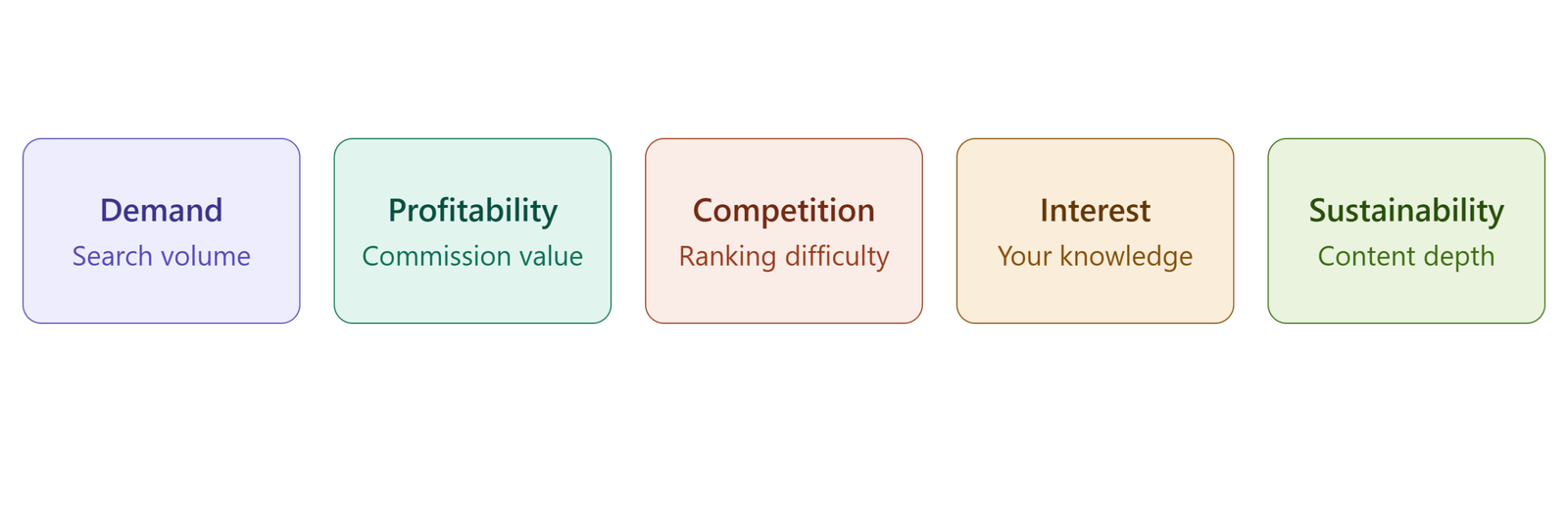
Before picking a niche, run it through these five filters. A strong niche should score well across most, if not all, of them. Weak niches usually fail on at least two of these criteria at once — which is exactly why running through all five, rather than picking your favorite one, matters.
1. Demand
Is there an active, ongoing search volume for topics in this niche? You can check this using free tools like Google Trends or paid tools like Ahrefs and SEMrush. Look for consistent or growing interest over the past 12–24 months — avoid niches that are declining sharply or purely seasonal (like “Halloween costume ideas”) unless you plan to diversify your content calendar to cover the off-season too. A niche with steady, year-round search interest gives you a more predictable, sustainable income stream than one with sharp spikes and long dry spells.
2. Profitability
Does the niche have affiliate programs that pay well? This includes both the commission percentage and the average order value of the products being promoted. A 5% commission on a $2,000 product often beats a 50% commission on a $20 product — the math matters more than the percentage alone. It’s also worth checking whether programs in your niche offer recurring commissions (paid every month a customer stays subscribed) versus one-time payouts, since recurring income compounds in a way one-time sales never will.
3. Competition
How many established websites are already ranking for your target keywords? Use tools to check the domain authority and content quality of the top-ranking pages for your main target terms. High competition doesn’t automatically mean “avoid it” — some of the most profitable niches are competitive precisely because they’re profitable. What it does mean is that you’ll need a smarter angle, like a hyper-specific sub-niche, a unique content format, or a distribution channel (like YouTube or Pinterest) that your competitors are ignoring.
4. Your Own Interest and Knowledge
Will you still want to write about this topic in six months? Twelve months? Two years? Affiliate marketing is a long game — most successful sites took 12 months or longer to become genuinely profitable — and genuine interest is often what keeps people showing up and publishing consistently when results are slow to arrive. Existing knowledge is a bonus too: it lets you produce more credible, detailed content faster than someone starting from zero.
5. Content Sustainability
Can you realistically produce 30, 50, or 100+ pieces of content in this niche without running out of ideas? Niches with many sub-topics, frequent product releases, and evolving trends (like technology or software) tend to offer more content longevity than static, one-time-purchase niches where you might exhaust every useful angle within your first 20 articles.
Affiliate Niches with the Highest Conversion Rates in 2026
One of the biggest mistakes beginners make is chasing the niches with the highest commission percentages without looking at conversion rates — how likely visitors actually are to buy. A niche with a huge commission but a tiny conversion rate can earn you less than a niche with a smaller commission but strong buyer intent. Here’s what the current data shows about where conversions are strongest right now, and why.
Health and Wellness
Health and pet-related niches currently show some of the strongest conversion performance in affiliate marketing, generally converting in the 5–6% range — well above the average across most affiliate categories. This is largely because buyer intent in these niches tends to be high: someone searching for a solution to their dog’s joint pain or their own sleep problems is usually close to a buying decision already. The content needed to convert a reader in this space doesn’t have to be complicated either — a clear, honest comparison of two products, backed by real experience, is often enough to move someone to buy.
AI Tools and SaaS
AI and software-as-a-service (SaaS) products have become one of the fastest-growing and highest-converting categories heading into 2026. Recurring commission structures — where you get paid monthly for as long as the customer stays subscribed — make this niche especially attractive for long-term income, with some programs offering commissions as high as 30% per month for the customer’s lifetime. Sub-niches like AI writing assistants, video automation tools, AI customer service platforms, and workflow software tend to convert noticeably better than broad “best AI tools” roundup articles, because they target a specific, well-defined problem rather than a vague, general audience.
Personal Finance
Finance remains one of the highest-paying niches on a per-conversion basis. While traffic and approval requirements can be tougher to access — many finance affiliate programs require higher domain authority, cleaner traffic sources, and sometimes country-specific compliance — the payout per single conversion can be substantial. A single approved credit card referral, for instance, can pay $100 to $300, which means even a modest conversion rate can produce strong overall returns compared to niches paying just a few dollars per sale.
Online Education and E-Learning
Education and e-learning affiliates report some of the highest average monthly incomes of any tracked niche, with figures suggesting affiliates in this space can earn well over $15,000 per month on average among top performers. This is driven by high-ticket courses and certifications, some of which cost well into the thousands of dollars, creating large payouts per individual sale rather than requiring huge volumes of low-value transactions.
Cybersecurity and VPNs
This niche benefits from strong customer retention — once someone buys security software and it’s working, they rarely cancel — which builds what’s sometimes called an “insurance mindset” among buyers. Commission rates in this space commonly range from 25% to 50%, and customers are generally comfortable paying $50 to $150 annually for the peace of mind these products provide, making it a stable, recurring niche for affiliates.
Gaming and Digital Products
Gaming remains a strong performer too, particularly for digital guides, in-game currency, and gaming peripherals. Commission rates can reach up to 50% for gaming guides and digital products, with premium gaming equipment commanding high average order values. The audience in this niche also tends to be passionate and prone to repeat purchases, which supports strong long-term revenue once you’ve built an engaged following.
What This Pattern Means for You
Notice a pattern across all of these: the highest-converting niches usually solve either an urgent problem (health, cybersecurity) or a high-value professional need (finance, SaaS, education). When you’re evaluating your own niche idea, ask yourself: does this solve a real, felt problem, or is it a “nice to have”? Problems people actively feel — pain, risk, missed income, wasted time — tend to convert far better than products people are only mildly curious about. This single question can save you months of wasted effort if you apply it honestly before committing to a niche.

New to affiliate marketing? Start with our beginner-friendly guide and learn the exact steps to build your first affiliate income online. https://ezmakaffiliates.com/affiliate-marketing-for-beginners-how-to-start/“
How Long It Takes to Start Earning, by Niche Type
One question beginners rarely ask — but should — is how long a niche typically takes to become profitable. This varies significantly, and setting the right expectations up front will save you from quitting too early.
Low-competition, low-ticket niches (like budget home décor or basic pet accessories) often produce their first small sales within 2–4 months, since ranking for less competitive terms happens faster. However, the income per sale tends to be modest, so meaningful revenue still takes time to accumulate.
Medium-competition, mid-ticket niches (like fitness equipment or productivity software) typically take 4–8 months before consistent sales appear, as you’re competing against more established sites, but the payout per conversion is higher once traffic starts arriving.
High-competition, high-ticket niches (like finance, insurance, or enterprise SaaS) often take 8–12 months or longer to show meaningful results, because these niches usually require more backlinks, more domain trust, and sometimes country-specific compliance work before affiliate programs will even approve your site. The payoff, when it arrives, tends to be substantially larger per sale than lower-ticket niches.
Understanding which category your chosen niche falls into helps you set a realistic timeline and avoid the common trap of assuming something isn’t working when it simply hasn’t had enough time yet.
Step-by-Step: How to Choose Your Affiliate Marketing Niche
Now let’s put it all together into a clear, repeatable process you can follow from start to finish.
Step 1: Brainstorm 10–15 Broad Interest Areas
Start wide. List every topic you have some knowledge of, curiosity about, or personal experience with — fitness, budgeting, gaming, pets, parenting, home improvement, tech gadgets, cooking, travel, and so on. Don’t filter or judge your ideas yet; the goal at this stage is simply to get as many raw ideas on paper as possible, since you’ll be narrowing things down in later steps anyway.
Step 2: Cross-Reference with High-Converting Categories
Compare your brainstormed list against categories known for strong conversion performance — health, finance, SaaS/AI tools, education, cybersecurity, and gaming, as covered in the previous section. Ideas that appear in both your personal interest list and the high-converting category list deserve extra attention, since they combine sustainability with real earning potential.
Step 3: Narrow Down to a Specific Sub-Niche
“Fitness” is too broad — thousands of established sites already compete for that exact word. “Home workout equipment for small apartments” is a niche. The more specific you get, the easier it becomes to rank in search engines, because you’re competing against far fewer pages, and the more targeted (and higher-converting) your resulting audience becomes, since every visitor arriving at your site is already interested in that exact, specific problem.
Step 4: Research Available Affiliate Programs
Search for affiliate programs tied to your chosen sub-niche using network directories like ShareASale, CJ Affiliate, ClickBank, and Impact, or by searching directly for “[brand name] affiliate program.” Check commission rates, cookie duration (how long you get credit for a referral after the click), payment thresholds, and approval requirements. A promising niche idea with no accessible, reputable affiliate programs behind it isn’t viable yet, no matter how much traffic potential it has.
Step 5: Check Keyword Search Volume and Competition
Use a free tool like Google’s Keyword Planner or Ubersuggest, or a paid tool like Ahrefs, to check whether people are actually searching for topics in your niche, and how difficult it looks to rank for those terms based on the authority of the sites currently occupying page one. If every top result is from a massive, well-established publisher, you’ll want to look for more specific long-tail variations where smaller, newer sites still have a realistic chance to rank.
Step 6: Validate with a Small Content Test
Before committing fully, publish 3–5 pieces of content in your chosen niche and observe engagement, early traffic, time-on-page, and any early affiliate clicks or sales. This is a low-risk way to test real-world demand before investing months of work into a niche that might not actually perform the way your research suggested it would.
Step 7: Commit and Build a Content Calendar
Once validated, commit to the niche and map out a content calendar covering the next 3–6 months of publishing. Consistency, not perfection, is what compounds into long-term search rankings and income — a niche you stick with and publish in regularly will almost always outperform a “perfect” niche you abandon after a few weeks.

Two Example Approaches to Niche Selection
To illustrate how the framework in this guide plays out in practice, here are two hypothetical but realistic scenarios showing different paths to a profitable niche.
Scenario A: The Interest-First Approach Someone passionate about home fitness starts by listing broad interests, then narrows “fitness” down to “resistance band workouts for small spaces” after noticing strong search demand but relatively low competition for that specific phrase. They check affiliate programs for resistance band brands and home fitness accessories, find solid commission rates, and validate the idea with five articles before committing fully. Within a few months, long-tail keywords start ranking, and consistent — if modest — commissions begin arriving.
Scenario B: The Data-First Approach Someone with a finance background starts from the high-converting categories list rather than a personal interest list, and settles on “budgeting tools for freelancers” — a sub-niche within personal finance that combines strong per-conversion payouts with a defined, underserved audience. Because finance affiliate programs often require higher domain trust, this approach takes longer to gain approval and visibility, but the eventual per-sale commissions are significantly higher than in lower-ticket niches.
Neither approach is “correct” — both follow the same underlying evaluation process, just starting from a different end of the funnel: personal interest versus market data. The important part is that both scenarios run their idea through the same five criteria — demand, profitability, competition, interest, and sustainability — before fully committing.
Combining a Main Niche with Profitable Sub-Topics
Once you’ve chosen and validated your core niche, you don’t have to limit yourself to a single narrow angle forever. Many successful affiliate sites start with one tightly focused sub-niche to build initial authority, then expand outward into closely related sub-topics once they’ve established trust with both readers and search engines.
For example, a site that starts with “home workout equipment for small apartments” might later expand into “meal prep for home fitness enthusiasts” or “recovery and mobility tools” — topics that share the same core audience but open up new affiliate programs and additional content opportunities. The key is expanding into adjacent topics your existing audience already cares about, rather than jumping into an unrelated niche that forces you to start building authority from zero all over again.
This approach lets you enjoy the ranking advantages of a narrow, focused niche early on, while still building toward a larger, more diversified site over time — one that isn’t dependent on a single product category or a single affiliate program for its income.
Common Mistakes When Choosing an Affiliate Niche
Avoid these frequent pitfalls that quietly derail otherwise promising affiliate marketing attempts.
- Choosing a niche based only on commission size. A high commission percentage means nothing if the products don’t convert. Always evaluate commission size alongside conversion rate and average order value, not in isolation, since the combination of all three determines your real earning potential.
- Picking something too broad. “Technology” or “health” are entire industries, not niches — they’re far too large for a single new website to meaningfully compete in. You need a specific angle, like a defined sub-topic or a defined audience segment, that you can realistically dominate.
- Ignoring your own interest level. Passion sustains you through the slow early months when results are thin and traffic is minimal. Choosing a niche purely for money, with zero genuine curiosity, is one of the most common reasons beginners quit within their first six months.
- Not checking if affiliate programs even exist. Some genuinely interesting, high-traffic topics simply don’t have viable, well-paying affiliate offers behind them. Always confirm monetization is realistically possible before building an entire content strategy around a topic.
- Copying a competitor’s niche exactly. Without a unique angle, sub-niche focus, or content format, you’ll struggle to differentiate yourself from an already-established competitor, and search engines have little reason to rank a near-duplicate of content that already exists.
- Ignoring competition research. Jumping into an oversaturated niche without any differentiation plan — no unique angle, no underserved sub-topic, no different content format — wastes months of writing effort that never has a realistic chance to rank.
- Switching niches too often. Constantly restarting from scratch every time results feel slow prevents you from ever building the topical authority search engines reward over time. Most niches genuinely need 6–12 months of consistent publishing before their full potential becomes visible.

Tools to Help You Research and Validate a Niche
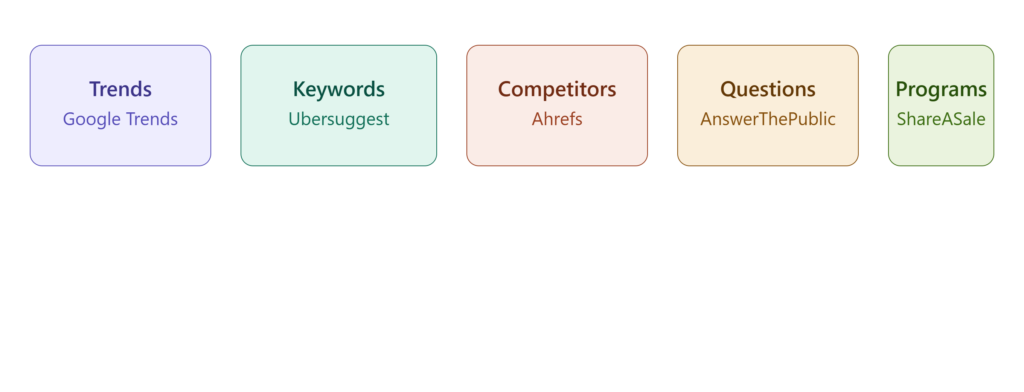
- Google Trends – See whether interest in a topic is rising, falling, or holding steady over time, and compare multiple potential niche ideas against each other directly.
- Google Keyword Planner / Ubersuggest – Check search volume and estimated keyword difficulty for the specific terms your future readers would actually type into Google.
- Ahrefs or SEMrush – Analyze competitor websites already ranking in your potential niche, including their traffic estimates, backlink profiles, and content gaps you could fill.
- AnswerThePublic – Discover the exact questions people are asking within a topic, which doubles as an instant content idea generator for your first few months of articles.
- Affiliate network directories (ShareASale, CJ Affiliate, ClickBank, Impact) – Search directly for available programs in your niche, along with their commission structures and approval requirements.
Examples of Profitable Niche Angles
To make this more concrete, here are examples of how a broad topic can be narrowed into a specific, higher-converting niche using the framework covered above — along with the reasoning behind each narrowing.
- Broad: Fitness → Specific: Home gym equipment for small apartments. This works because it targets a specific living situation, letting you speak directly to space constraints that generic fitness content ignores.
- Broad: Finance → Specific: Budgeting apps for freelancers. Freelancers face irregular income, a problem regular employees don’t share, which makes generic budgeting advice far less useful to them.
- Broad: Tech → Specific: AI writing tools for small business owners. This avoids competing with massive general “best AI tools” roundups by focusing on one clear buyer persona with a specific need.
- Broad: Pets → Specific: Natural remedies and gear for senior dogs. Aging pets create an urgent, emotionally driven need that converts far better than generic “pet care tips.”
- Broad: Travel → Specific: Solo travel gear and safety products for women. This combines a defined audience with products tied directly to a felt concern — personal safety — which supports strong buyer intent.
- Broad: Gaming → Specific: Ergonomic gear for competitive PC gamers. Long gaming sessions create real physical discomfort, giving this sub-niche a genuine problem-solution angle rather than just enthusiast content.
- Broad: Education → Specific: Online certification courses for career changers. People actively changing careers are highly motivated buyers compared to casual browsers of “online course” content.
Each of these narrower angles makes it easier to build topical authority, rank in search engines faster, and speak directly to a reader’s specific problem — which, as we covered earlier, is exactly what drives higher conversion rates compared to broad, generic content.
Signs You’ve Found the Right Niche
After going through the research and validation process, how do you actually know when you’ve landed on a good niche rather than just a decent one? A few signals tend to show up consistently:
- You can list 30+ content ideas without much effort. If topic ideas come easily and naturally, the niche likely has enough depth to sustain months or years of publishing.
- Early test content gets some traction, even if small. A handful of visitors, a few email signups, or an early affiliate click within the first few weeks is a strong signal that real demand exists.
- You find yourself reading about the topic even when you’re not “working.” This is one of the clearest signs that your interest is genuine rather than manufactured for the sake of profitability.
- Affiliate programs approve you without excessive friction. If multiple relevant programs accept your application relatively smoothly, it usually means the niche isn’t oversaturated with low-quality applicants or restricted to only major, established publishers.
- Competitors in the space are beatable. When you review the top-ranking pages for your target keywords and notice thin content, outdated information, or weak on-page SEO, that’s a realistic opening for a new site to compete.
If most of these signs are present, you’re likely looking at a niche worth committing to fully rather than continuing to search endlessly for a “perfect” option that doesn’t exist.
A Note on Disclosure and Trust in Any Niche
Whichever niche you choose, one requirement stays constant: clear, honest affiliate disclosure. Regulations such as the FTC guidelines in the United States require that readers know when a link is an affiliate link before they click it, and enforcement against poor or missing disclosure has increased in recent years. Beyond the legal requirement, disclosure also builds trust — readers who know you may earn a commission, but still find your recommendation genuinely helpful, are more likely to return and to buy. Whatever niche you settle on, build honest, transparent disclosure into your content from your very first post rather than treating it as an afterthought.
Frequently Asked Questions (FAQ)
1. How do I know if a niche is profitable before starting?
Check whether legitimate affiliate programs exist in that niche, review their commission structures and average order values, and validate real search demand using keyword research tools before committing significant time or effort to content creation. Publishing a handful of test articles before going all-in is one of the most reliable ways to confirm profitability with real data rather than assumptions.
2. Should I pick a niche based on passion or profitability?
Ideally both. Passion keeps you consistent long-term, especially during the slow early months, but profitability ensures your effort actually converts into meaningful income. Look for the overlap between what you genuinely enjoy and what the data shows converts well — that overlap is usually where the most sustainable niches live.
3. How narrow should my niche be?
Narrow enough to target a specific, well-defined audience with a clear, felt problem, but broad enough that you can realistically create dozens of content pieces over time without running out of relevant ideas within your first few months. If you struggle to list at least 20–30 potential article topics, your niche may be too narrow.
4. Can I change my niche later if it’s not working?
Yes, but give it enough time first — at least 3–6 months of consistent, quality effort — before deciding whether to pivot, since most niches genuinely take time to gain meaningful search visibility and trust. Pivoting too early is one of the most common reasons beginners never see their initial efforts pay off.
5. Do high-commission niches always convert better?
No. A niche can offer a large commission percentage but still convert poorly if buyer intent is low or the products are impulse-driven rather than solution-driven. Conversion rate and commission size need to be evaluated together, not separately, to understand your true earning potential.
6. What’s the difference between a niche and a sub-niche?
A niche is a general topic area (like “fitness”), while a sub-niche is a specific, targeted segment within it (like “home workout equipment for small apartments”). Sub-niches usually convert better and face significantly less competition than their broader parent niche, especially for newer websites.
7. How many niches should a beginner focus on at once?
Just one. Spreading your early efforts across multiple niches dilutes your content authority and makes it much harder to rank in search engines. Master one niche fully — including building real traffic and consistent conversions — before expanding into a second.
Quick Recap Checklist Before You Commit
Before you fully commit to a niche and start building your content calendar, run through this final checklist:
- [ ] Does the niche show consistent or growing search demand over the past 12–24 months?
- [ ] Are there legitimate, well-paying affiliate programs available in this niche?
- [ ] Have you checked the competition level for your target keywords, and identified a realistic angle to differentiate yourself?
- [ ] Are you genuinely interested in this topic, beyond just its earning potential?
- [ ] Can you list at least 20–30 content ideas without struggling?
- [ ] Have you validated the idea with a small batch of test content before going all-in?
- [ ] Do you understand the realistic timeline for this niche based on its competition and ticket size?
If you can check off most or all of these boxes, you have a solid, well-researched foundation to build on — one grounded in evidence rather than guesswork, which puts you well ahead of most beginners entering affiliate marketing this year.
Conclusion
Choosing a profitable affiliate marketing niche isn’t about guessing or chasing whatever seems trendy this month — it’s about running your ideas through a clear, repeatable evaluation process: demand, profitability, competition, personal interest, and content sustainability. When you combine that process with an understanding of which niches are currently converting best — health, AI/SaaS, finance, education, cybersecurity, and gaming, in particular — you put yourself in a far stronger position than most beginners who skip this step entirely and pick a niche on impulse.
Take the time to research before you commit. A well-chosen niche is the foundation everything else in your affiliate marketing business will be built on, and the hours you invest here will save you months of wasted effort later.
Ready to find your niche and start building? Explore more in-depth guides at [ezmakaffiliates.com].
New to affiliate marketing? Start with our beginner-friendly guide and learn the exact steps to build your first affiliate income online. https://ezmakaffiliates.com/affiliate-marketing-for-beginners-how-to-start/
Don’t miss our newest affiliate marketing tips, SEO guides, and online income strategies. Subscribe to our newsletter and get notified whenever we publish a new article.