
If most of the affiliate programs you’ve come across so far focus on physical products, digital courses, or general consumer goods, PartnerStack stands out for a different reason entirely: it’s built specifically around B2B SaaS companies — software businesses that sell to other businesses, often at higher price points and with longer sales cycles than typical consumer products.
This review breaks down exactly what PartnerStack is, how it works, its commission structure, and — most importantly — whether it’s genuinely a good fit for your specific site and niche before you invest time applying. As covered in our broader guide to affiliate programs, not every program deserves your attention just because it exists, and PartnerStack’s B2B focus makes it a meaningfully different fit than general marketplaces like Amazon or ClickBank.
Want to increase your affiliate sales and build a long-term online business? Learn how email marketing can help you grow your audience and boost conversions. https://ezmakaffiliates.com/email-marketing-for-affiliates/
What Is PartnerStack?
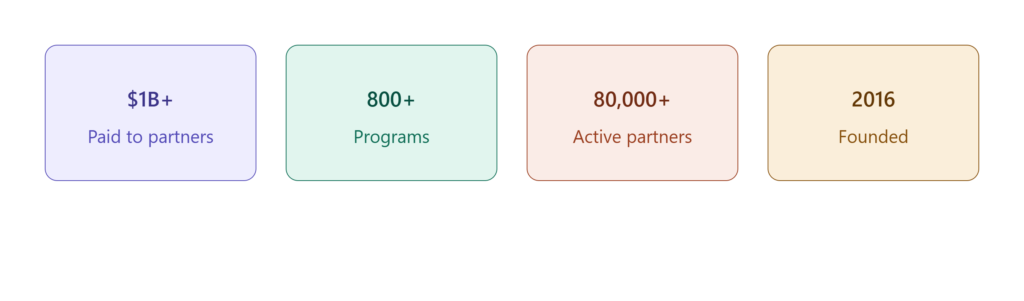
PartnerStack launched in 2016 as a partnership management platform built specifically for B2B software companies looking to scale growth through affiliates, referral partners, and resellers. Rather than being a single affiliate program, it functions similarly to a network like ShareASale or CJ Affiliate — a central hub connecting individual affiliates (“partners,” in PartnerStack’s terminology) with a marketplace of participating companies.
Over its history, the platform has processed more than $1 billion in total partner commissions and now supports over 800 partner programs and more than 80,000 active partners. Its target companies are almost exclusively B2B software businesses — think project management tools, marketing platforms, HR software, and similar products sold primarily to other businesses rather than individual consumers.
This B2B focus is PartnerStack’s defining characteristic, and it shapes almost everything else about the platform, from typical commission structures to the kind of content and audience that tends to perform well promoting programs found there.
How PartnerStack Works: Network vs. Marketplace Structure
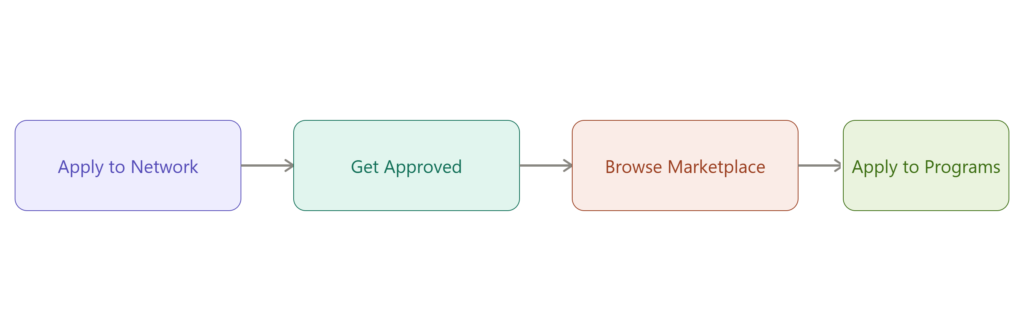
Understanding PartnerStack’s two-step structure is essential before applying, since it differs from single-program affiliate signups you may be used to.
Step 1: Join the PartnerStack Network. Before you can apply to any individual program, you first need to be approved for the overall PartnerStack Network. This is a relatively lightweight application — PartnerStack specifically markets requiring only 8 to 10 pieces of information about you as a partner, notably less than some other networks that ask for 20 or more. You’ll be asked what type of partner you are (content creator, influencer, agency, and so on), with no single answer type disadvantaging your application.
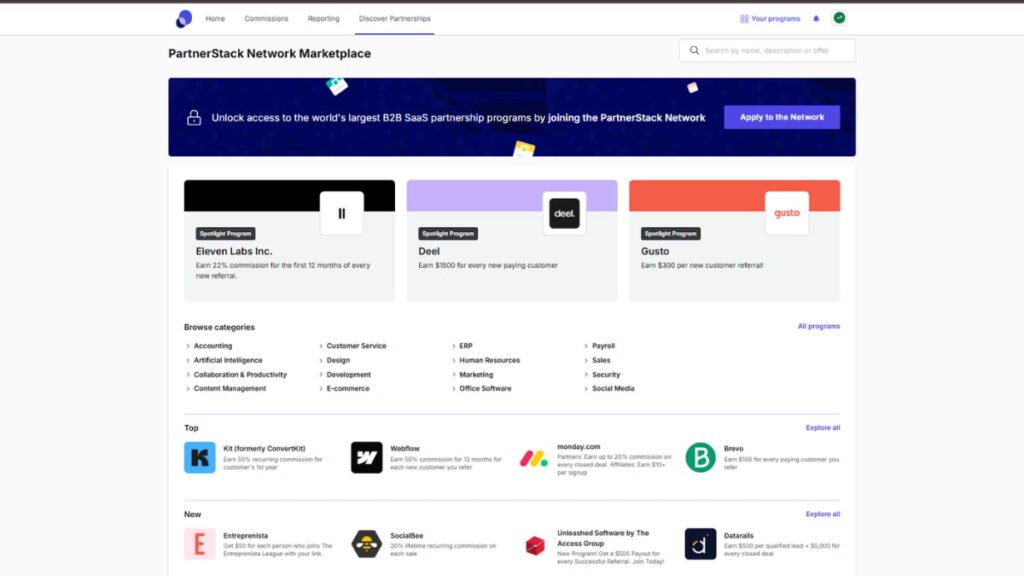
Step 2: Browse and apply to individual programs. Once approved for the Network, you gain access to the Marketplace, where you can browse all 800+ available programs, sorted by category, and apply to the specific ones relevant to your niche and content. Each individual program owner reviews and approves partner applications separately, meaning Network approval doesn’t guarantee approval into every program — some programs are more selective than others.
This two-tier structure is worth understanding upfront: getting into the Network is the easier first step, while getting accepted into specific high-value programs within the Marketplace may require more relevant content, traffic, or audience fit depending on that individual company’s requirements.
Categories of Programs Available in the Marketplace
Once approved for the Network, the range of programs available inside PartnerStack’s Marketplace spans several recognizable B2B software categories, giving affiliates in adjacent niches multiple relevant options to explore rather than just one narrow product type.
Common categories include project management and productivity tools, aimed at teams and businesses looking to streamline workflows; marketing and sales software, covering everything from email platforms to CRM and lead generation tools; HR and recruiting platforms, serving businesses managing hiring and team operations; developer and technical tools, including software aimed at engineering and IT teams; and finance and operations software, covering invoicing, accounting, and business operations platforms.
This category breadth means affiliates don’t need to cover software exclusively to find a fit — a site focused on remote work, entrepreneurship, freelancing, or small business operations can often find several relevant programs across these categories, rather than being limited to a single narrow product type. Browsing the Marketplace by category before applying broadly is a practical way to identify which specific programs genuinely align with your existing content, rather than applying to whatever appears first.
PartnerStack’s Own Program vs. Marketplace Programs — An Important Distinction
It’s worth clearly separating two related but distinct things: PartnerStack’s own affiliate program (promoting PartnerStack itself, the platform) and the hundreds of individual company programs available inside its Marketplace once you’re approved as a Network partner.
Joining PartnerStack’s own affiliate program means you’re specifically promoting PartnerStack as a product — relevant primarily if your audience includes SaaS founders or partnership managers who might consider adopting the platform themselves. This is a narrower, more specific opportunity than the Network application, and it comes with its own dedicated commission terms, currently structured around the 15% first-year rate mentioned earlier.
Separately, becoming a Network partner is what unlocks access to browse and apply to the 800+ other companies’ programs — completely separate businesses using PartnerStack as their partnership management infrastructure, each with their own individual commission rates, target audiences, and approval requirements. For most affiliates, the real long-term value lies in this broader Marketplace access, not necessarily in promoting PartnerStack itself, unless your specific audience happens to be a strong fit for that particular product.
Commission Rates, Cookie Duration & Payment Details
Commission structures on PartnerStack vary significantly by individual program, since each participating company sets its own rates — but a few general patterns and platform-wide details are worth knowing.
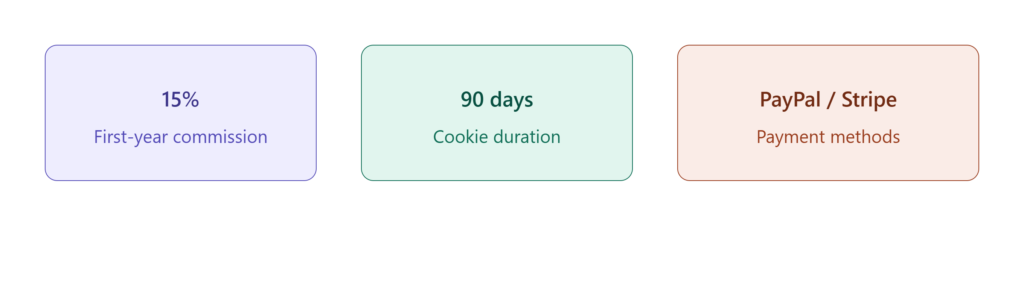
PartnerStack’s own affiliate program (promoting PartnerStack itself, distinct from the individual programs inside its marketplace) offers 15% commission on referred customers during their first year. This is a commonly cited benchmark rate across many programs on the platform, though it’s worth noting this is a first-year-only structure for standard affiliates, rather than a lifetime recurring commission — some competing SaaS affiliate programs elsewhere offer ongoing recurring commissions for as long as a customer remains subscribed, which is a meaningful difference worth weighing.
Cookie durations on PartnerStack tend to run generously, commonly around 90 days, which is considerably longer than many general marketplace programs and gives you credit for a much wider window after a reader clicks your link.
Payment methods commonly supported include both PayPal and Stripe, offering broader international accessibility than some networks limited to a single payout method. Minimum payout thresholds and exact payment schedules vary by individual program, so it’s worth checking specific terms once you’re approved into a program you’re interested in promoting.
How to Apply and Get Approved
Applying to PartnerStack follows a clear, structured process, and understanding what improves your approval odds can save you time and frustration.
- Create your PartnerStack partner profile, providing basic information about your business, website, and how you operate as a partner (content creator, affiliate, agency, and so on).
- Complete your profile thoroughly. According to PartnerStack’s own guidance, partners who fully complete their profile are notably more likely to be accepted into programs — reportedly around 75% more likely — making this a genuinely worthwhile step rather than something to rush through.
- Submit your Network application and wait for review. This step focuses on overall partner quality and fit rather than any single program’s specific requirements.
- Once approved, browse the Marketplace and identify programs relevant to your niche and content, prioritizing quality fits over applying broadly to everything available.
- Apply to individual programs, tailoring your application where possible to explain specifically how your audience and content align with that company’s product.
- Wait for program-level approval, which is reviewed separately by each company and can take anywhere from a few days to longer, depending on the individual program.
Given PartnerStack’s B2B SaaS focus, sites and content creators covering business tools, marketing software, productivity platforms, or similar B2B-adjacent topics tend to have a stronger natural fit — and correspondingly stronger approval odds — than sites focused purely on unrelated consumer niches.

Pros of Joining PartnerStack
- Low barrier to entry for the Network itself. No minimum traffic, follower count, or geographic restriction is required to apply, making it genuinely accessible to newer affiliates, unlike some premium SaaS programs with stricter baseline requirements.
- Access to 800+ programs from one dashboard. Once approved for the Network, you can browse and apply to a large marketplace of B2B software programs without needing to manage dozens of separate logins and applications from scratch.
- Generous 90-day cookie duration. This gives considerably more credit-window flexibility than many general marketplace programs, which matters for B2B purchases that often involve longer consideration periods than typical consumer products.
- Established, reliable track record. With nine-plus years of operation and over $1 billion paid to partners, PartnerStack has a documented history of paying affiliates, reducing the reliability concerns that come with newer, unproven programs.
- Multiple payment methods. Support for both PayPal and Stripe offers more international payout flexibility than networks limited to a single payment option.
- Free to join with no hidden costs. There are no application fees or subscription requirements at any point in the process, from application through your first payout.
- Transparent, end-to-end referral tracking. The platform tracks referrals through the full funnel and surfaces which content and links are actually driving results, supporting the kind of data-driven optimization covered in our income breakdown guide.
- Support for multiple partner types. Beyond individual affiliates, PartnerStack accommodates agencies, consultants, and resellers, which can be a relevant path for affiliates who later expand into offering partnership consulting services alongside their content.

What Real Partners Say About PartnerStack
Beyond the platform’s own marketing claims, it’s worth considering how existing partners describe their actual day-to-day experience using PartnerStack. Common themes across partner reviews highlight the platform’s usability specifically: several reviewers point to an intuitive interface with a clear left-hand navigation panel, making it straightforward to find affiliate links, promo codes, and sales reporting all in one place.
The Marketplace browsing experience is another frequently praised feature — partners commonly note that discovering additional relevant programs to join feels notably easier on PartnerStack than on some other platforms, thanks to organized categories and a searchable interface. Reporting and analytics also receive consistent positive mention, with partners describing the dashboard as easy to read and understand compared to some competing networks with more cluttered or confusing reporting tools.
These usability-focused strengths matter in practice: a platform that makes it simple to track performance, discover new relevant programs, and manage multiple partnerships from one place reduces the administrative overhead of affiliate marketing — time that can instead go toward content creation and traffic building, the activities that actually drive income.
A Sample Content Strategy for Using PartnerStack
To make this more concrete, here’s how a hypothetical business-and-productivity-focused affiliate site might realistically incorporate PartnerStack into its broader content and program strategy.
After building initial content around a core topic like “tools for remote teams” or “software for small business owners,” the site owner applies to the PartnerStack Network, completing their profile fully to maximize approval odds. Once approved, they browse the Marketplace by category, identifying three or four programs — perhaps a project management tool, a marketing platform, and an HR software product — that align naturally with content they’ve already published or plan to publish soon.
Rather than writing generic “best software” roundups immediately, they prioritize in-depth, single-product reviews and comparison posts for each approved program, following the content structure and SEO practices covered in earlier guides in this series. As these specific programs begin converting, the site tracks performance per program, as recommended earlier, doubling down on whichever ones show the strongest earnings per click relative to the traffic each article receives.
Over time, this focused approach — rather than applying broadly to dozens of unrelated programs — builds both stronger program relationships and more genuinely useful, converting content, illustrating how PartnerStack’s marketplace structure works best when treated as a curated set of relevant partnerships rather than an undifferentiated pool to promote indiscriminately.
Cons and Limitations to Consider
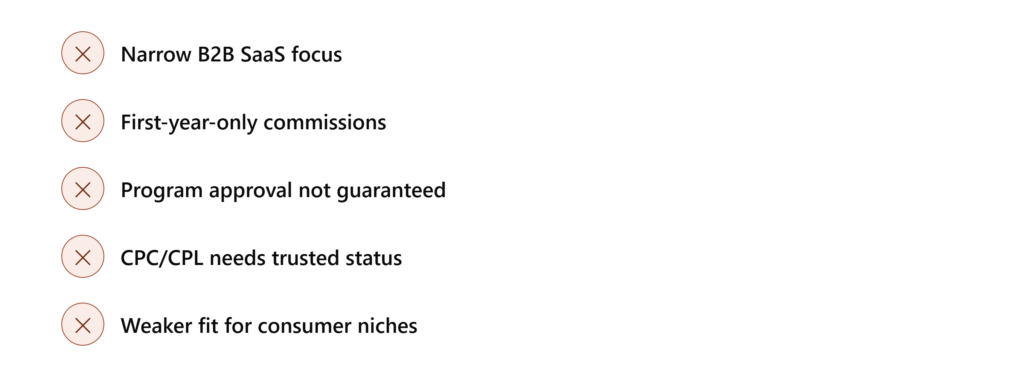
- Niche-specific focus limits broad applicability. PartnerStack’s near-exclusive B2B SaaS focus means it’s a poor fit for sites covering unrelated consumer niches like fashion, food, or general lifestyle content, unlike broader marketplaces such as Amazon or ShareASale.
- First-year-only commissions on many programs. Unlike some competing SaaS affiliate programs offering lifetime recurring commissions, PartnerStack’s own program — and reportedly many within its marketplace — commonly cap standard commissions at the customer’s first year.
- Individual program approval isn’t guaranteed. Network approval only opens the door to applying for individual programs; higher-value or more selective programs within the marketplace may still decline applicants who don’t demonstrate strong topical or audience fit.
- Advanced commission models require established status. Certain pricing models like CPC or CPL are generally restricted to “trusted partner” status, meaning newer affiliates typically need to build a track record on the platform before accessing them.
- Lower conversion potential for non-business audiences. Given the platform’s B2B enterprise target customer, content creators with primarily consumer-focused or solopreneur audiences may see comparatively lower conversion rates than those with genuinely business-focused readers.
- Longer B2B sales cycles can delay visible results. Business software purchasing decisions often take longer than typical consumer purchases, meaning the generous 90-day cookie window, while helpful, doesn’t fully eliminate a naturally slower conversion timeline compared to impulse-driven consumer niches.
- Marketplace quality and terms vary by individual program. Since each company inside the marketplace sets its own commission structure and requirements, affiliates need to evaluate individual programs carefully rather than assuming uniform terms across the entire platform.
PartnerStack vs. Other Affiliate Networks
How does PartnerStack compare to more general affiliate networks covered in our earlier programs guide, like ShareASale, CJ Affiliate, and Impact?
Niche focus: PartnerStack is narrowly focused on B2B SaaS, while ShareASale, CJ Affiliate, and Impact host a much broader range of merchants spanning fashion, consumer goods, and general e-commerce alongside software. If your content is B2B or software-focused, PartnerStack’s specialization can be an advantage; if it isn’t, the broader networks likely offer more relevant options.
Approval accessibility: PartnerStack’s Network-level application is notably lightweight, and the platform explicitly markets having no minimum traffic or follower requirements — a more accessible entry point than some individual SaaS programs that require an established site before considering an application.
Commission structure: Commission rates and structures vary by individual program on every network, but PartnerStack’s commonly cited first-year-only model is worth comparing carefully against recurring-commission programs available both within its own marketplace and on competing networks, since recurring income compounds differently than one-year-capped commissions, as covered in our earlier guide on high-ticket versus recurring programs.
Cookie duration: PartnerStack’s commonly cited 90-day cookie window compares favorably to shorter-duration programs like Amazon’s 24-hour cookie, though it’s roughly in line with generous cookie durations offered by some other established networks as well.
Curious about how much affiliate marketers really earn? Discover the realistic income ranges, key factors that affect earnings, and what you can expect as a beginner in 2026. https://ezmakaffiliates.com/how-much-do-affiliate-marketers-really-make/
Who Is PartnerStack Best Suited For?
Given everything covered so far, PartnerStack is a particularly strong fit for:
- B2B and business-focused content creators already covering productivity tools, marketing software, HR platforms, or similar business-oriented topics.
- Sites in adjacent professional niches — like marketing, sales, entrepreneurship, or remote work — where recommending relevant SaaS tools fits naturally into existing content.
- Affiliates seeking a diversified software program portfolio without managing dozens of separate individual program relationships, thanks to the centralized Marketplace structure.
- Newer affiliates without an established track record, given the platform’s relatively accessible baseline Network application requirements.
It’s a comparatively weaker fit for sites focused purely on unrelated consumer niches — as covered throughout our niche selection guide, matching a program’s focus to your own content and audience remains one of the most important factors in whether a partnership actually converts, regardless of how strong the platform itself is.
Want to rank your affiliate content higher on Google? Learn the latest affiliate SEO strategies to boost rankings, increase traffic, and grow your commissions. https://ezmakaffiliates.com/affiliate-marketing-seo-how-to-rank-google/
Tips for Getting Approved by Individual Programs Inside the Marketplace
Getting into the PartnerStack Network is only the first step — here’s how to improve your odds with the individual, potentially more selective programs inside the Marketplace itself.
- Complete your partner profile in full detail before applying to anything, since a thorough profile has been directly linked to meaningfully higher program acceptance rates.
- Prioritize programs genuinely relevant to your existing content, rather than applying broadly to everything available — a tailored, relevant application signals better fit than a generic one.
- Reference specific content you’ve already published relevant to a program’s product category when applying, if the application allows for additional context.
- Build a small amount of relevant content first if your site doesn’t yet cover B2B or software topics, giving program reviewers concrete evidence of fit before you apply.
- Start with more accessible programs to build a track record on the platform, which can support stronger applications to more selective, higher-value programs later on.
Want to create realistic AI voiceovers, voice cloning, and professional audio content? Read our in-depth ElevenLabs review to see if it’s the right tool for your needs. https://ezmakaffiliates.com/elevenlabs-review-2026/
Common Mistakes When Using PartnerStack
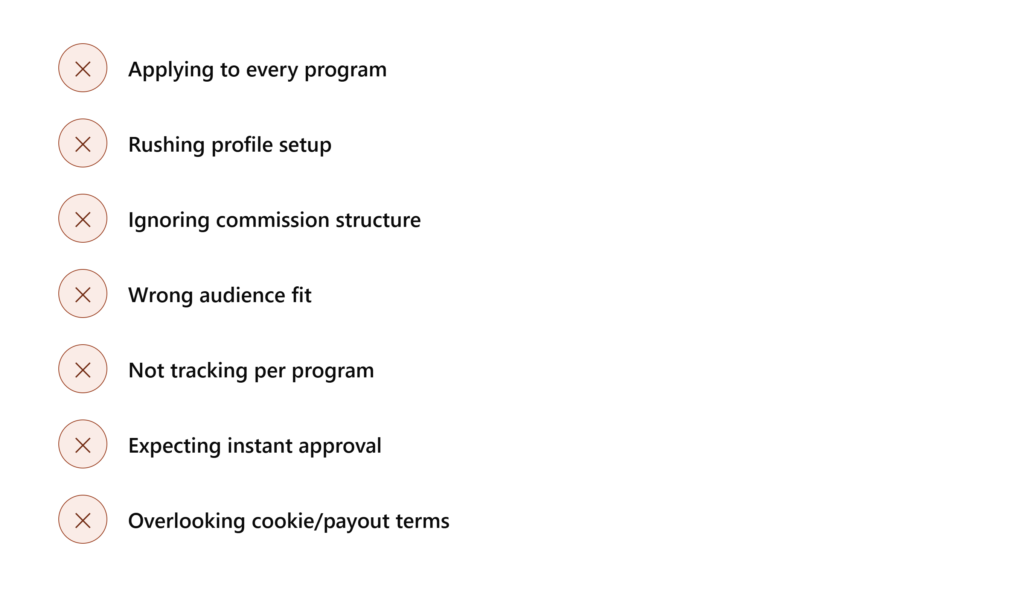
- Applying to every available program regardless of fit. A scattershot approach dilutes your ability to write genuinely relevant, converting content about any single program, echoing a mistake covered in our broader programs guide.
- Rushing through the initial profile setup. Given the direct link between profile completeness and approval rates, treating this step casually reduces your odds unnecessarily.
- Ignoring the first-year-only commission structure when comparing programs. Assuming all commissions work identically to lifetime recurring models can lead to inaccurate income expectations.
- Promoting B2B software to a clearly consumer-focused audience. Mismatched audience fit tends to produce weak conversion rates regardless of how generous a program’s commission terms are.
- Not tracking which specific programs are actually converting. As covered in our programs guide, tracking performance by individual program — rather than treating the whole marketplace as one undifferentiated source — reveals which specific partnerships deserve continued focus.
- Expecting instant approval into premium programs. Some higher-value programs within the marketplace favor partners with an established track record, so newer affiliates should expect to build credibility over time rather than gaining access to everything immediately.
- Overlooking cookie duration and payout thresholds when comparing programs. These practical details, covered earlier in this review, meaningfully affect real earning potential beyond the headline commission percentage alone.
Frequently Asked Questions (FAQ)
1. Is PartnerStack free to join?
Yes. There are no application fees, subscription costs, or any charges at any point in the process, from your initial application through your first payout.
2. Do I need a minimum amount of traffic to join PartnerStack?
No. PartnerStack explicitly markets having no minimum traffic, follower count, or geographic restriction for Network approval, making it accessible to newer affiliates, though individual programs within the marketplace may still favor applicants with stronger topical fit.
3. How is PartnerStack different from Amazon Associates or ShareASale?
PartnerStack focuses almost exclusively on B2B SaaS companies, while Amazon Associates and ShareASale span a much broader range of consumer and general e-commerce merchants — making PartnerStack a better fit specifically for business and software-focused content.
4. Does PartnerStack offer recurring commissions?
Commission structures vary by individual program, but many, including PartnerStack’s own affiliate program, commonly use a first-year-only commission model rather than lifetime recurring payments — worth confirming per program before assuming otherwise.
5. How long does PartnerStack approval typically take?
Network-level approval is generally reviewed relatively quickly given the streamlined application, while individual program approval within the Marketplace varies by company and can take anywhere from a few days to longer.
6. Can complete beginners get approved for PartnerStack?
Yes, at the Network level — there’s no minimum traffic or follower requirement. However, more selective individual programs within the Marketplace may still favor applicants with relevant, established content.
7. What kind of content performs best for PartnerStack programs?
Content covering B2B software, business productivity tools, marketing platforms, and similar professional or enterprise-focused topics tends to align best with the programs available on PartnerStack’s marketplace.
8. Is PartnerStack a good fit for a brand-new affiliate site?
It can be, given the accessible Network-level application, but new sites will likely have stronger success starting with a handful of relevant, well-matched programs and building content depth there rather than applying broadly across the entire marketplace immediately.
9. Can I use PartnerStack alongside other affiliate networks?
Yes — as covered in our broader programs guide, most successful affiliates diversify across multiple networks and program types rather than relying on a single platform, and PartnerStack can serve as the B2B/SaaS-focused component of a more varied program portfolio.
Final Verdict: Rating PartnerStack by Category
Pulling together everything covered in this review, here’s a summary rating across the factors that matter most when evaluating any affiliate program, as outlined in our broader programs guide.
Approval accessibility: Strong. No minimum traffic or follower requirement for Network-level approval makes this one of the more accessible B2B-focused platforms available to newer affiliates.
Commission value: Moderate. The commonly cited first-year-only structure is a genuine limitation compared to lifetime recurring competitors, though individual programs within the marketplace vary and some may offer more favorable terms.
Cookie duration: Strong. A 90-day window is generous, particularly well-suited to the longer consideration periods common in B2B software purchasing decisions.
Platform usability: Strong. Consistent positive feedback on dashboard clarity, reporting, and marketplace navigation reduces the administrative burden of managing multiple program relationships.
Niche breadth: Narrow by design. This is a genuine limitation only if your content doesn’t align with B2B software — for the right niche fit, the specialization is actually a strength rather than a weakness.
Payment reliability: Strong. A nine-plus year track record and over $1 billion paid to partners provides real, documented reassurance on this front.
Overall, PartnerStack earns a solid recommendation specifically for B2B, SaaS, marketing, and business-focused affiliate sites — and a clear pass for sites in unrelated consumer niches where the platform’s specialization simply won’t apply.
Key Takeaways Before You Apply
- PartnerStack’s Network-level application is genuinely accessible, with no minimum traffic or follower count required — but individual programs within the Marketplace still evaluate fit separately.
- The commonly cited first-year-only commission structure is worth weighing against recurring-commission alternatives elsewhere, especially for a long-term content strategy.
- The platform’s B2B SaaS specialization is a strength for business-focused affiliates and a genuine mismatch for unrelated consumer niches — know which category your site falls into before investing application time.
- A focused approach, applying to a handful of genuinely relevant programs rather than the entire marketplace, tends to produce stronger content and better results than a scattershot strategy.
- A completed, detailed partner profile meaningfully improves approval odds and is worth the extra time before submitting your application.
Conclusion
PartnerStack fills a genuinely useful niche within the broader affiliate marketing landscape: a relatively accessible, well-established network specifically built for B2B SaaS partnerships, offering a large marketplace of programs from one central dashboard. Its low barrier to entry, generous cookie duration, and documented payment track record make it a reasonable option to consider — provided your content and audience genuinely align with its business-software focus.
As with every program covered in our broader guide, the right question isn’t simply “is this a good program” in isolation, but “is this a good program for my specific niche and audience.” For B2B, SaaS, marketing, or business-focused affiliates, PartnerStack is worth serious consideration; for sites in unrelated consumer niches, the broader, more general networks covered elsewhere in this series are likely to be a stronger fit. Whichever direction fits your site, apply the same evaluation criteria consistently — commission value, cookie duration, approval accessibility, and genuine niche relevance — rather than joining a program simply because it’s well-known or easy to get into.
Ready to evaluate more affiliate programs for your niche? Explore more in-depth guides at [ezmakaffiliates.com].
Looking for discounted business-class flights and luxury travel deals? Read our in-depth AranGrant review to discover its features, pricing, pros, cons, and whether it’s worth using in 2026. https://ezmakaffiliates.com/arangrant-review-2026/