

Of every traffic strategy available to affiliate marketers, none compounds quite like SEO. A well-optimized article can keep bringing in visitors — and commissions — for years after you hit publish, with little to no ongoing effort required to maintain it. But SEO for affiliate content isn’t quite the same as general SEO. Affiliate sites face extra scrutiny from Google, stricter expectations around trust and disclosure, and a uniquely commercial type of search intent to satisfy.
Many affiliate marketers approach SEO the way they’d approach any other blog — publish content, add keywords, and hope for the best. But affiliate content carries an inherent commercial purpose that search engines are specifically trained to evaluate more carefully than a purely informational blog post. Understanding this distinction from the start will save you from strategies that work fine for general content but quietly hold back — or even penalize — a site built around affiliate recommendations.
In this guide, we’ll cover exactly how to approach SEO for affiliate marketing in 2026 — from keyword research and on-page optimization, to the technical basics, link building, and the specific mistakes that get affiliate sites penalized or simply ignored by Google. We’ll also cover a realistic timeline for what to expect, how to build genuine topical authority, and how the rise of AI-powered search is changing the game for affiliate marketers specifically.
Looking for the best affiliate programs to maximize your earnings? Explore our top picks for beginners and experienced marketers alike. https://ezmakaffiliates.com/best-affiliate-marketing-programs-to-join/
Why SEO Matters More Than Any Other Traffic Channel for Affiliates
Social media traffic is fast but temporary — a post’s reach typically dies out within a day or two. Paid ads stop the moment your budget runs out. SEO is different: an article that ranks well can continue attracting new, high-intent visitors for years, often with minimal additional work beyond occasional updates.
This compounding effect matters enormously for affiliate marketers specifically, because it means your past effort keeps paying dividends into the future. Publish 50 well-optimized articles over a year, and by year two, you’re not starting from zero — you’re building on top of an already-growing base of ranking content, each piece still pulling in its own share of traffic and commissions.
SEO traffic also tends to convert better for affiliate content than most other channels, since visitors arriving from a specific, well-matched search query already have a clear problem in mind — they’re not scrolling passively through a feed, they’re actively searching for a solution, which puts them much closer to a buying decision than a typical social media visitor.
Want more visitors and clicks on your affiliate content? Check out our proven traffic-generation strategies to grow your audience and increase conversions. https://ezmakaffiliates.com/how-to-drive-traffic-to-your-affiliate-links/
Keyword Research for Affiliate Content
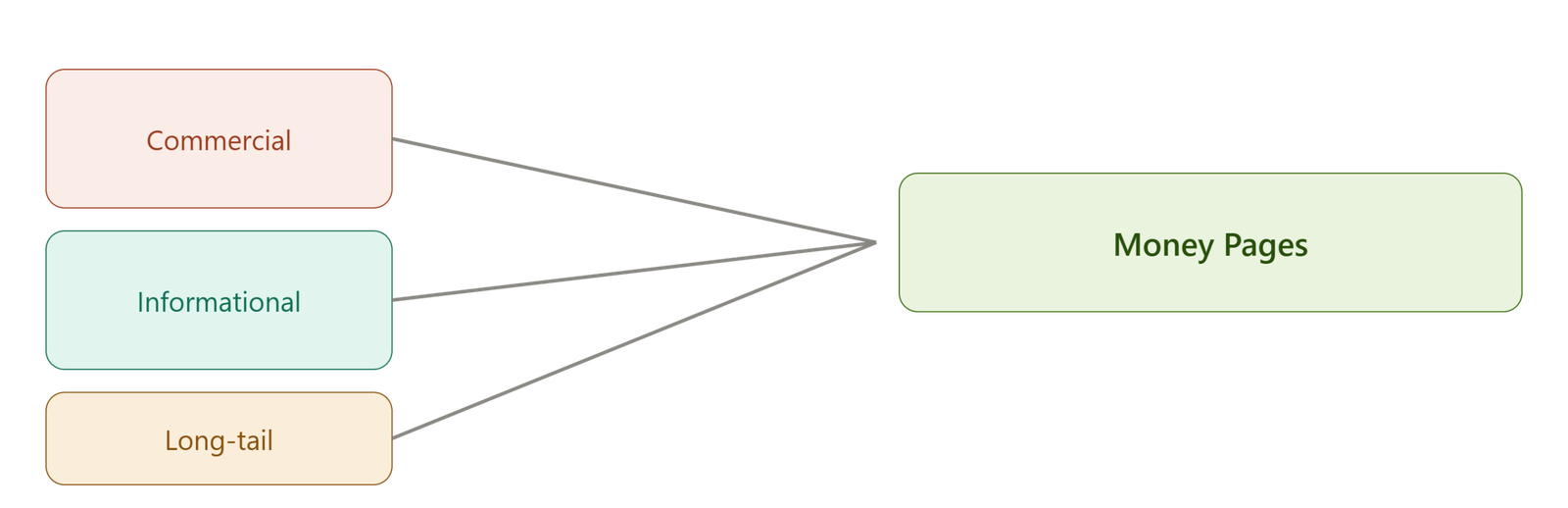
Not all keywords are created equal for affiliate marketing. Understanding the different categories helps you build a balanced content strategy rather than only chasing one type.
Commercial and Transactional Keywords
These are keywords with clear buying intent — phrases like “best [product] for [use case],” “[product] review,” or “[product A] vs [product B].” These are your money pages, directly linking to affiliate offers, and they typically convert at the highest rate since the searcher is close to a purchase decision.
Informational Keywords
Broader questions like “how does [product category] work” or “what is [topic]” attract readers earlier in their research process. These pages build topical authority and internal linking opportunities, even though they convert at a lower rate individually.
Long-Tail Keywords
Highly specific phrases like “best budgeting app for freelance graphic designers” carry lower search volume individually, but far lower competition and often higher conversion rates, since they match a very specific searcher need almost exactly.
Keyword Research Tools
- Google Keyword Planner – Free, and useful for checking baseline search volume.
- Ahrefs or SEMrush – Paid tools offering deeper competition analysis and keyword difficulty scores.
- Google’s “People Also Ask” and autocomplete – Free ways to discover related questions and phrases real searchers are typing.
- AnswerThePublic – Generates question-based keyword ideas, useful for informational content planning.
A balanced content plan mixes all three keyword types: a handful of commercial “money pages” targeting your best affiliate offers, supported by a broader base of informational content that builds topical authority and links back to those money pages.
Building Topical Authority with Content Clusters
Rather than publishing isolated articles targeting individual keywords, current SEO best practice favors building “content clusters” — a group of related articles all covering different angles of the same core topic, tightly interlinked with each other.
A typical cluster starts with a broad “pillar” page covering a topic comprehensively, supported by several narrower articles that each dive deeper into a specific sub-topic, all linking back to the pillar page and to each other where relevant. For example, a pillar page on “home workout equipment” might be supported by narrower articles on “best resistance bands,” “best adjustable dumbbells,” and “home gym setups for small apartments” — each linking back to the main pillar and to each other where the content naturally overlaps.
This structure signals genuine topical depth to search engines, which increasingly reward sites that demonstrate comprehensive coverage of a niche over sites publishing scattered, unconnected articles across many unrelated topics. It also improves the user experience, since readers can naturally navigate from a general overview into more specific content that matches their exact question, keeping them engaged with your site longer and increasing the odds of an eventual affiliate conversion.
Structured keyword mapping — deciding in advance which keyword each planned article will target — also helps prevent “content cannibalization,” where two of your own pages compete against each other for the same search term instead of each capturing a distinct, valuable slice of search traffic.
On-Page SEO for Affiliate Content
On-page SEO is where you directly influence how both Google and readers perceive a specific piece of content. For affiliate sites, this needs to balance ranking potential with genuine click-through and conversion potential at the same time.
- Title tags should include your target keyword naturally, often paired with benefit-focused or comparison language that speaks to commercial searchers — something like “Best [Product] for [Specific Use Case] — 2026 Reviews and Comparisons” tends to perform well for exactly this reason.
- Meta descriptions should emphasize the comprehensiveness of your content and hint at the decision-making value inside, since this is what actually drives the click once your page appears in search results.
- Heading structure (H2/H3) should organize content logically around sub-topics and related questions, which helps both readability and Google’s ability to understand what each section covers.
- Affiliate link attributes matter more than many beginners realize — Google’s current guidance is that affiliate and other paid or sponsored links should carry a
rel="sponsored"orrel="nofollow"attribute, which helps you stay compliant and avoid manual penalties for undisclosed paid links. - Internal linking between related articles on your own site helps distribute authority across your content and keeps readers engaged with more of what you’ve published.
- Images with descriptive alt text improve accessibility and give you an additional, smaller opportunity to rank in Google Image search for relevant terms.
None of these elements exist in isolation from user experience — Google’s own guidance increasingly treats genuine helpfulness and clarity as inseparable from ranking signals, particularly following recent updates focused on rewarding “helpful content.”

Content Structure That Actually Ranks
Different search intents call for different content formats, and matching format to intent is often more important than raw writing quality alone.
- Comparison posts (“X vs Y”) work best as structured breakdowns covering price, features, and clear use-case recommendations, ideally supported by a comparison table readers can scan quickly.
- “Best of” listicles should include enough individual detail per item that each entry could function as a mini-review on its own, rather than a single vague sentence per product.
- In-depth single reviews perform best when they demonstrate genuine, first-hand use — original photos, screenshots, or specific details that couldn’t be copied from a manufacturer’s spec sheet.
- Buying guides work well for informational-commercial hybrid searches, walking a reader through what to look for before recommending specific options.
A growing theme across current SEO guidance for affiliate content is the importance of demonstrating genuine, first-hand experience with a product — generic, clearly unoriginal summaries increasingly underperform compared to content showing real testing, use, and specific detail that reflects actual hands-on experience rather than a repackaged spec sheet.
Technical SEO Basics for Affiliate Sites
Beyond content itself, the technical foundation of your site plays a real role in how well it ranks and how readers experience it.
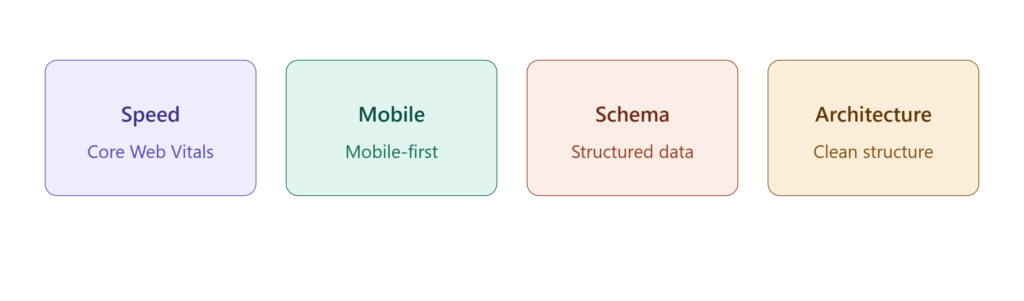
- Site speed remains a consistent ranking factor, and slow-loading pages also hurt conversions directly, since visitors frequently abandon pages that take too long to load, especially on mobile.
- Mobile-friendliness is essential, since the majority of search traffic now arrives from mobile devices, and Google evaluates your site’s mobile version as the primary version for ranking purposes.
- Schema markup (structured data) helps search engines understand your content more precisely, and can unlock rich snippets like star ratings or FAQ dropdowns directly in search results, which tend to improve click-through rates significantly.
- Clean site architecture — a logical structure of categories and internal links — helps both search engines and readers navigate your content, and supports the topical authority that current search algorithms increasingly reward.
- Core Web Vitals (loading performance, interactivity, and visual stability) continue to factor into rankings, particularly for competitive commercial keywords where many sites are otherwise similar in content quality.
Link Building for Affiliate Sites
Backlinks remain one of the strongest ranking signals available, but affiliate sites need to build them thoughtfully, since a spammy or manipulative backlink profile can do real damage.
- Guest posting on relevant, reputable sites in your niche remains one of the most reliable ways to earn quality backlinks while also reaching a new audience.
- Resource page outreach — finding pages that list helpful resources in your niche and requesting inclusion — can produce high-quality, relevant links with relatively low effort.
- Original research and data tend to attract natural backlinks from other writers looking to cite a useful statistic or study, since unique data is inherently more link-worthy than opinion or rehashed information.
- Digital PR and expert quotes — offering commentary to journalists or bloggers covering your niche — can produce valuable, high-authority backlinks over time.
It’s worth noting clearly: affiliate links themselves are not inherently bad for SEO, as long as your content can stand on its own merit and your site isn’t over-saturated with low-value affiliate links stuffed in without context. The concern from Google isn’t affiliate links existing — it’s affiliate content that exists purely to funnel clicks without offering genuine value first.
Optimizing for Featured Snippets and “People Also Ask”
Beyond standard organic rankings, Google frequently displays featured snippets — short, extracted answers shown directly at the top of search results — along with “People Also Ask” boxes containing related questions. Capturing these positions can significantly boost visibility, even for pages that don’t rank first in the standard results below them.
To improve your chances of earning a featured snippet, structure content to directly and concisely answer common questions within the first sentence or two of a relevant section, ideally under a clear, question-phrased heading. Numbered lists, definition-style paragraphs, and short comparison tables also tend to perform well for snippet capture, since Google’s systems can extract them cleanly.
Reviewing the “People Also Ask” questions that already appear for your target keywords is also a reliable way to discover exactly what related sub-questions your content should address — each one represents a real, common question searchers are asking, giving you a built-in outline for making your content more comprehensive and more likely to satisfy search intent fully.
Avoiding Google Penalties as an Affiliate Site
Because affiliate content is inherently commercial, it draws extra scrutiny from Google’s quality systems. A few practices help keep your site in good standing:
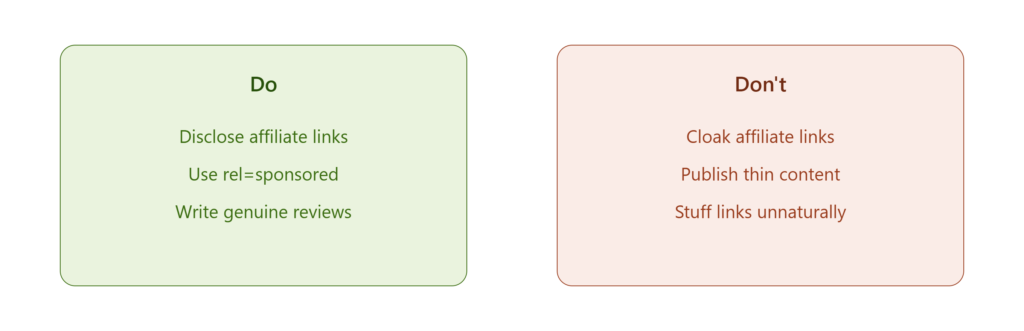
- Avoid thin, templated content. Pages that add little beyond a product name, price, and a generic one-line description tend to be specifically targeted by Google’s Helpful Content system.
- Never cloak or hide affiliate links from users. Presenting one thing to Google’s crawlers and something different to actual visitors is a manipulative practice that can result in a manual penalty.
- Disclose your affiliate relationships clearly. This satisfies both FTC requirements and Google’s own guidance on trustworthy, transparent commercial content.
- Avoid excessive, unnatural affiliate link density. Stuffing a page with affiliate links at the expense of readability and genuine helpfulness is a clear signal of low-quality, purely commercial intent.
- Build genuine topical authority. Sites that cover a coherent niche in depth tend to be treated as more trustworthy and authoritative than those covering many unrelated topics purely for traffic volume.
Balancing SEO with Conversion Rate Optimization
It’s possible to rank an article well and still earn very little from it if the page fails to actually convert readers into clicks and sales. SEO gets a reader to your page; conversion rate optimization (CRO) is what turns that visit into a commission — and the two need to work together rather than being treated as separate concerns.
Practical ways to blend the two include placing clear, well-labeled call-to-action buttons near your most persuasive content (not just buried at the very bottom of a long article), using comparison tables that make decision-making easy at a glance, and ensuring your strongest recommendation is clearly highlighted rather than lost among a dozen equally-weighted options.
It’s worth periodically testing different link placements, button wording, and content structures on your highest-traffic pages specifically, since even a well-ranking article with a low conversion rate leaves real income on the table — often more than could be gained by ranking for an additional new keyword entirely.
How Long SEO Takes for Affiliate Sites — A Realistic Timeline
Patience is one of the most underrated skills in affiliate SEO. Based on typical patterns across the industry, new affiliate sites generally begin seeing initial organic traffic within 3 to 6 months of consistent publishing, with more significant traffic growth commonly appearing between months 6 and 12 as your site accumulates both content volume and backlinks.
Building genuinely substantial revenue, however, usually requires 12 to 24 months of consistent effort, particularly in competitive niches where established sites already dominate the top rankings. This timeline varies considerably based on niche competition, content quality, and how comprehensively you cover your chosen topic area — a narrow, well-covered niche can sometimes show results faster than a broad, highly competitive one, even with less total content published.
Setting these expectations early helps you avoid the common trap of abandoning SEO efforts after just a few weeks or months, mistakenly assuming the strategy isn’t working when it simply hasn’t had enough time to mature yet.

A Sample SEO Growth Timeline in Practice
To make the timeline above more concrete, here’s what a realistic progression might look like for a new affiliate site publishing consistently, one to two articles per week, in a moderately competitive niche.
Months 1–3: Little to no organic traffic yet, since new content typically needs time to be crawled, indexed, and gradually evaluated by search engines. This period is best spent building a strong content foundation — a mix of pillar and cluster content — rather than expecting or chasing early traffic numbers.
Months 4–6: Early keyword rankings begin appearing, usually for longer-tail, lower-competition terms first. Traffic remains modest, but the first trickle of organic visitors — and often the first few affiliate commissions — typically start arriving during this window.
Months 7–12: Rankings for more competitive keywords start improving as the site accumulates more backlinks, more internal links, and stronger topical authority from its growing content library. Traffic and income growth tend to accelerate more noticeably during this stage.
Months 13–24: For sites that have maintained consistent publishing and content updates, this is typically when SEO traffic and affiliate income reach a genuinely sustainable, meaningful level — though continued content production and refreshing remain important even after this point, since competitors and search algorithms both continue to evolve.
This timeline isn’t a guarantee — niche competition, content quality, and consistency all shift it earlier or later — but it reflects the general pattern most affiliate sites experience when SEO is approached patiently and systematically rather than abandoned early.
Keeping Content Fresh: Why Updating Old Posts Matters
Publishing new content isn’t the only lever available for growing affiliate SEO traffic — updating and refreshing older articles is often faster and more efficient, since you’re improving a page that already has some existing authority rather than starting entirely from zero.
Regularly revisit your top-performing and near-ranking pages (those sitting on page two of search results, close to breaking into page one) and update outdated statistics, refresh screenshots, add new product options, and expand thin sections with more detail. Search engines tend to favor recently updated, accurate content over stale pages, particularly in fast-moving niches like technology or software where product details change frequently.
A simple, sustainable approach is to dedicate a portion of your regular publishing schedule — for example, one week out of every month — specifically to updating older content rather than only producing new articles. This habit compounds over time, gradually strengthening your entire existing content library rather than only growing it in raw volume.
A Pre-Publish SEO Checklist for Affiliate Content
Before hitting publish on any new affiliate article, running through a quick checklist helps ensure you’re not missing basic opportunities that are easy to fix before the page goes live:
- [ ] Does the title tag include your target keyword naturally, without feeling forced?
- [ ] Does the meta description clearly communicate the article’s value and encourage a click?
- [ ] Are headings (H2/H3) structured logically around sub-topics and related questions?
- [ ] Do affiliate links carry the appropriate
rel="sponsored"orrel="nofollow"attributes? - [ ] Is there a clear, visible affiliate disclosure near the top of the content?
- [ ] Are there at least two or three internal links to other relevant articles on your site?
- [ ] Do images have descriptive alt text, and are file sizes optimized for fast loading?
- [ ] Does the content demonstrate genuine, first-hand detail rather than reading like a generic summary?
- [ ] Is the content genuinely comprehensive enough to fully satisfy the search intent behind the target keyword?
Running through this list consistently, article after article, builds strong SEO habits that eventually become automatic, rather than requiring conscious effort on every single post.
SEO in the Age of AI-Powered Search
One of the biggest shifts affecting affiliate SEO in 2026 is the rise of AI-driven search experiences — Google’s AI Overviews, along with platforms like ChatGPT and Perplexity, can now answer many informational queries directly, without requiring a click through to any website at all. This has measurably reduced click-through rates for some purely informational search queries.
The practical implication for affiliate marketers is a shift in where to focus: purely informational queries that AI can fully answer on its own are becoming less valuable traffic targets, while highly specific, commercial, comparison-driven queries — where a searcher genuinely needs a detailed, trustworthy recommendation rather than a quick factual answer — remain strong opportunities, since AI summaries are far less equipped to replace a genuine, detailed product comparison or first-hand review.
This also reinforces the importance of E-E-A-T (Experience, Expertise, Authoritativeness, Trustworthiness) as a content strategy, not just an SEO checkbox. Content that demonstrates real, first-hand product experience — genuine photos, specific details, honest pros and cons — is both harder for AI systems to fully replicate and more likely to be trusted and clicked through by readers who do land on it. Diversifying your traffic sources beyond search alone, as covered in a previous guide on driving traffic, is also an increasingly important hedge against this ongoing shift in how people search.
How Comprehensive Should Affiliate Content Be?
A common question beginners ask is exactly how long or detailed a piece of affiliate content needs to be to rank well. The honest answer is that length itself isn’t the ranking factor — comprehensiveness relative to search intent is. A simple, narrow question might be fully answered in 800 words, while a genuine “best of” comparison covering ten products with detailed pros, cons, and use cases might reasonably need 3,000 words or more to do the topic justice.
That said, most successful affiliate articles tend to fall in the 2,000 to 4,000 word range, largely because commercial, comparison-driven content naturally requires enough detail to help a reader make a confident purchasing decision — covering price, features, pros, cons, and alternatives in enough depth that the reader doesn’t feel the need to open five other tabs to fill in gaps you left out.
Rather than padding content to hit an arbitrary word count, a more reliable approach is to ask: “Does this fully answer everything a genuinely undecided buyer would want to know before purchasing?” If the honest answer is no, there’s a gap worth filling — regardless of whether that brings the article to 1,500 words or 4,000.
Common SEO Mistakes Affiliate Marketers Make
- Targeting only broad, high-competition keywords. Chasing terms like “best headphones” without a realistic path to outrank established, high-authority sites wastes months of effort. Long-tail, specific keywords are typically far more achievable for newer sites.
- Publishing thin, templated reviews. Content that reads like it was generated from a spec sheet, without genuine detail or first-hand insight, increasingly underperforms following Google’s Helpful Content updates.
- Ignoring internal linking. Failing to connect related articles on your own site wastes an easy opportunity to distribute authority and keep readers engaged with more of your content.
- Neglecting technical SEO. A slow, poorly structured, or non-mobile-friendly site can undermine even genuinely excellent content, since technical issues affect both rankings and user experience directly.
- Covering too many unrelated topics. Sites that jump between unrelated niches struggle to build the topical authority that search algorithms increasingly reward in favor of focused, specialized publishers.
- Skipping proper link attributes. Failing to mark affiliate links with appropriate
relattributes can trigger manual penalties, even when the underlying content itself is genuinely high quality. - Giving up before SEO has time to work. As covered above, meaningful results typically take 3–6 months at minimum, and abandoning the strategy earlier than that rarely gives it a fair chance to prove itself.

Tools for Affiliate SEO
- Google Search Console – Free, essential for monitoring rankings, click-through rates, and indexing issues directly from Google itself.
- Google Analytics – Tracks visitor behavior, traffic sources, and conversion paths across your site.
- Ahrefs or SEMrush – Paid tools for keyword research, competitor analysis, and backlink tracking.
- Screaming Frog – A technical SEO crawler that identifies broken links, missing meta tags, and other on-page issues across your entire site.
- PageSpeed Insights – Free tool for diagnosing and improving site speed and Core Web Vitals scores.
Frequently Asked Questions (FAQ)
1. Do affiliate links hurt my site’s SEO?
No, affiliate links themselves aren’t inherently harmful to SEO, as long as your content provides genuine value on its own and you use appropriate rel="sponsored" or rel="nofollow" attributes on commercial links to stay compliant with Google’s guidelines.
2. How long does affiliate SEO take to show results?
Most new affiliate sites see initial organic traffic within 3–6 months, with more significant growth between months 6–12, while building substantial revenue typically takes 12–24 months of consistent, quality effort.
3. What’s the ideal word count for affiliate content?
Most successful affiliate articles in 2026 range from 2,000 to 4,000 words, though the right length ultimately depends on your topic’s complexity and what’s genuinely needed to thoroughly answer the searcher’s question.
4. Is keyword research still important with AI search on the rise?
Yes, but the focus is shifting toward highly specific, commercial, comparison-driven keywords where AI Overviews are less likely to fully satisfy the searcher, rather than purely informational queries an AI can answer directly.
5. What is E-E-A-T and why does it matter for affiliate sites?
E-E-A-T stands for Experience, Expertise, Authoritativeness, and Trustworthiness — a framework Google’s quality evaluators use to assess content quality. It matters enormously for affiliate sites specifically because genuine first-hand experience and honest, transparent content are what separate trustworthy affiliate sites from low-quality, purely promotional ones.
6. Should I focus on one niche for better SEO results?
Yes. Sites that cover a single, coherent niche in depth tend to build stronger topical authority and are treated as more trustworthy by search algorithms than sites covering many unrelated topics.
7. How many backlinks do I need to rank an affiliate site?
There’s no fixed number — quality and relevance matter far more than raw quantity. A handful of genuinely relevant, high-authority backlinks typically outperforms dozens of low-quality, unrelated ones.
8. Is it better to update old content or publish new articles?
Both matter, but updating older, near-ranking pages is often faster and more efficient in the short term, since you’re improving a page that already has some existing authority rather than starting completely from zero.
9. How has AI-powered search changed affiliate SEO strategy?
It has shifted the focus toward highly specific, commercial, comparison-driven content that AI Overviews are less equipped to fully replace, while making purely informational, easily-summarized content a less reliable long-term traffic target on its own.
Conclusion
SEO remains the most durable, compounding traffic strategy available to affiliate marketers, but succeeding at it in 2026 requires more than old-school keyword stuffing or thin, templated reviews. It requires genuine keyword research across commercial and informational intent, solid on-page and technical foundations, thoughtful link building, real conversion-focused design, and — increasingly — real, demonstrable first-hand experience that both readers and AI-era search systems can recognize as trustworthy.
It also requires patience. Unlike paid ads or viral social posts, SEO rewards consistency over months rather than instant results — but that same patience is exactly what builds a durable, compounding asset that keeps generating income long after a single social post would have been forgotten. Treat your SEO strategy as an ongoing practice rather than a one-time setup: publish consistently, update what you’ve already built, and refine based on what the data shows is actually working.
Combine the SEO practices in this guide with the niche selection, traffic diversification, and program selection strategies covered in previous guides, and you’ll have a complete, sustainable foundation for long-term affiliate marketing success.
Ready to put this into practice? Explore more in-depth guides at [ezmakaffiliates.com].
Want to choose a profitable niche? Read our complete guide before you start building your affiliate website. https://ezmakaffiliates.com/how-to-choose-a-profitable-affiliate-marketing-niche/
Don’t miss our newest affiliate marketing tips, SEO guides, and online income strategies. Subscribe to our newsletter and get notified whenever we publish a new article.



One Response