
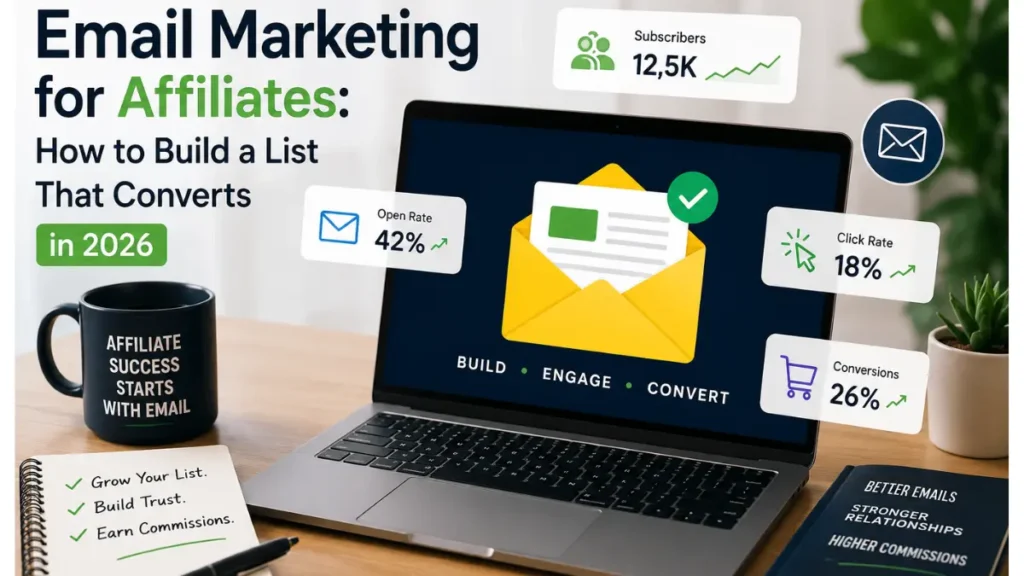

If you’ve read the other guides in this series, you already know that traffic is the fuel behind every successful affiliate site. But not all traffic is created equal — and email is arguably the most valuable channel of all, since every subscriber has already opted in, already trusts you enough to hand over their inbox, and is far more likely to convert than a cold visitor arriving from search or social media for the first time.
The data backs this up clearly: affiliates who use email marketing report earning meaningfully more than those who don’t, and email consistently delivers one of the highest returns on investment of any marketing channel available — commonly cited between $36 and $42 in revenue for every $1 spent. Yet many affiliate marketers treat email as an afterthought, if they build a list at all.
In this guide, we’ll cover exactly how to build an email list that converts — from choosing a platform and creating lead magnets, to writing a welcome sequence, segmenting your audience, and promoting affiliate links without feeling spammy. We’ll also cover the compliance basics every affiliate marketer needs to know.
Want to rank your affiliate content higher on Google? Learn the latest affiliate SEO strategies to boost rankings, increase traffic, and grow your commissions. https://ezmakaffiliates.com/affiliate-marketing-seo-how-to-rank-google/
Why Email Marketing Matters More Than Ever for Affiliates
As covered in our traffic and SEO guides, relying entirely on search engines or social platforms carries real risk — algorithm changes, AI-powered search overviews, and shifting platform policies can all impact your traffic overnight, through no fault of your own. Email is different: it’s a channel you fully own, with no algorithm standing between you and your audience’s inbox.
The data on email’s effectiveness for affiliates specifically is striking. Affiliates who incorporate email marketing into their strategy report earning roughly 66% more on average than those who rely solely on other channels. Around half of affiliate marketers now use email and newsletters as part of their regular promotional mix, recognizing it as one of the highest-converting channels available to them.
Beyond raw conversion numbers, email offers something search and social traffic can’t: repeated, direct access to an audience that has already expressed interest in your niche. A single blog visitor might never return to your site again, but a subscriber remains reachable for every future piece of content, product recommendation, or seasonal promotion you send — turning a one-time visit into an ongoing relationship.
Looking for the best affiliate programs to maximize your earnings? Explore our top picks for beginners and experienced marketers alike. https://ezmakaffiliates.com/best-affiliate-marketing-programs-to-join/
Choosing an Email Marketing Platform
Before building your list, you’ll need a platform to manage subscribers, design emails, and automate your sequences. A few factors matter most when choosing one as an affiliate marketer specifically.
- Affiliate-friendly terms of service. Some platforms restrict or closely monitor affiliate link promotion, so it’s worth confirming a platform explicitly allows affiliate marketing content before building your entire list around it.
- Automation capabilities. Automated welcome sequences and behavior-triggered emails consistently outperform one-off manual campaigns — current data shows automated flows generating vastly more revenue per email sent than standard batch campaigns, despite making up a small fraction of total emails sent.
- Segmentation features. The ability to tag and segment subscribers by interest or behavior lets you send more relevant offers, which directly impacts both engagement and conversion rates.
- Pricing that scales with your list size. Most platforms charge based on subscriber count, so it’s worth understanding how costs will grow as your list expands, rather than only evaluating the entry-level price.
- Landing page and form builder tools. Built-in signup form and landing page creation saves you from needing separate tools just to start capturing subscribers.
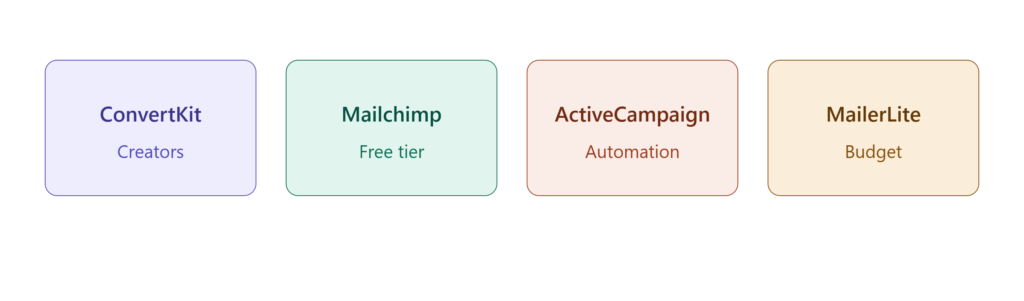
Popular options among affiliate marketers include ConvertKit (strong for creators and simple automation), Mailchimp (broad feature set with a free starter tier), ActiveCampaign (advanced automation and segmentation), and MailerLite (budget-friendly with solid core features). The right choice depends less on any single “best” platform and more on matching features to your specific list size, budget, and technical comfort level.
Building Your List: Lead Magnets That Actually Convert
A lead magnet is a free resource offered in exchange for an email address, and its quality directly determines how many visitors convert into subscribers. Generic, low-effort lead magnets tend to attract low-quality subscribers who never engage, while specific, genuinely useful ones attract subscribers who are primed to trust — and eventually buy from — your recommendations.
Effective lead magnet formats for affiliate sites include:
- Checklists and cheat sheets that distill a longer article into an actionable, printable format — these tend to have broad appeal and low production effort.
- Comparison charts summarizing your top product recommendations in one downloadable resource, which naturally reinforces the affiliate content readers already engaged with.
- Mini email courses delivered over several days, which double as a built-in welcome sequence while delivering genuine value.
- Discount codes or exclusive deals, where available through your affiliate programs, which combine list-building directly with a purchase incentive.
- Templates or calculators relevant to your niche — a budgeting spreadsheet for a finance site, or a workout tracker for a fitness site, for example.
The strongest lead magnets share one trait: they solve a narrow, specific problem completely, rather than offering a vague, broad promise. “5 Mistakes to Avoid When Buying a Home Gym” converts better than a generic “Fitness Tips” download, because it promises something concrete and immediately useful rather than something abstract.
Want more visitors and clicks on your affiliate content? Check out our proven traffic-generation strategies to grow your audience and increase conversions. https://ezmakaffiliates.com/how-to-drive-traffic-to-your-affiliate-links/
Where to Place Signup Forms for Maximum Conversions
Even the best lead magnet won’t convert well if it’s hidden where readers rarely see it. Strategic placement across your site meaningfully impacts your overall signup rate.
- In-content forms, placed naturally partway through a high-traffic article, tend to convert well since the reader is already engaged with related content at that exact moment.
- Exit-intent popups, which trigger when a visitor’s cursor movement suggests they’re about to leave the page, capture visitors who might otherwise never return.
- After-post forms, placed at the end of an article once the reader has finished consuming the content and is deciding what to do next.
- Sidebar or sticky bar forms, offering persistent, low-friction visibility without interrupting the reading experience.
- Dedicated landing pages, built specifically to promote your best lead magnet, useful for driving signups directly from social media bios or paid traffic.
Testing multiple placements on your highest-traffic pages specifically, rather than assuming one placement works universally, tends to reveal meaningful differences in conversion rate — a placement that performs well on a long, detailed comparison post might underperform on a short, quick-answer article.

A Realistic List Growth Timeline
Setting honest expectations for list growth helps avoid the discouragement that comes from comparing your early numbers to an established affiliate’s current list size. Here’s what a typical growth pattern looks like for a new affiliate site building its list alongside its content.
Months 1–3: With limited site traffic still developing, list growth is usually slow — often just a handful of subscribers per week, primarily from early content and initial signup form placement. This period is best spent focusing on creating a genuinely strong lead magnet rather than obsessing over subscriber counts that traffic simply can’t support yet.
Months 4–8: As SEO traffic begins to build, following the timeline discussed in our SEO guide, list growth typically accelerates alongside it, since a larger flow of engaged visitors naturally produces more signups even at a consistent conversion rate.
Months 9–18: With a more established content base and refined signup placements, many affiliate sites see list growth become a reliable, steady source of new subscribers each month, often reaching several hundred to a couple thousand total subscribers by this stage, depending on niche and traffic volume.
Beyond 18 months: For sites with strong, compounding SEO traffic and multiple well-placed lead magnets, list growth can become one of the site’s most predictable, self-sustaining assets — continuing to add subscribers steadily even during periods when active content production slows down.
As with SEO and overall income, patience is the common thread: list building compounds over time rather than happening overnight, and the subscribers you gain in year one become an increasingly valuable asset as your relationship with them — and your content library — continues to grow.
The Welcome Sequence: Your First 5 Emails
The welcome sequence — the automated series of emails a new subscriber receives immediately after signing up — is arguably the single highest-leverage piece of email content you’ll create, since it reaches 100% of your subscribers at their most engaged moment.
Email 1: Deliver the lead magnet and set expectations. Immediately deliver what was promised, thank the subscriber, and briefly explain what kind of content they can expect going forward and how often.
Email 2: Share your story or site’s purpose. Briefly explain why you started your site and what makes your recommendations trustworthy — genuine, specific detail here builds far more credibility than a generic “welcome to my newsletter” message.
Email 3: Point to your best, most valuable content. Link to your most comprehensive, highest-value article or guide, giving new subscribers an easy way to explore more of what you offer beyond the lead magnet itself.
Email 4: Introduce a relevant product recommendation. This is often the first email where an affiliate link naturally appears, framed around solving a specific problem rather than feeling like a direct sales pitch.
Email 5: Invite engagement. Ask a simple question — what they’re struggling with, what content they’d like to see — both to build a two-way relationship and to gather insight that can shape your future content and segmentation.
Spacing these emails a day or two apart, rather than sending all five immediately, tends to maintain engagement better than an overwhelming initial burst, while still delivering the sequence within roughly the first one to two weeks of a new subscription.

Email Metrics That Actually Matter
Tracking the right metrics helps you understand whether your email strategy is genuinely working, rather than just assuming it is. A few numbers matter more than others for affiliate-focused email marketing specifically.
- Open rate reflects how compelling your subject lines are, with current industry averages sitting around 30% and trending upward. Worth noting: open rate tracking has become less reliable in recent years due to privacy features on some email clients that can inflate the metric artificially, so it shouldn’t be treated as the primary success indicator on its own.
- Click-through rate (CTR) measures how many recipients actually clicked a link inside your email, and is generally a more reliable engagement signal than open rate alone, since it reflects genuine interest in the content rather than just a passive glance at an inbox.
- Click-to-conversion rate tracks how many of those clicks turned into an actual affiliate sale, and current data shows this specific metric climbing significantly as personalization and segmentation practices improve — meaning fewer total clicks, but a higher share of those clicks converting into purchases.
- Unsubscribe rate signals whether your content or sending frequency is misaligned with subscriber expectations. A small, steady unsubscribe rate is normal and even healthy, as it naturally filters your list toward more engaged subscribers over time, but a sudden spike after a specific email is worth investigating.
- List growth rate tracks how quickly you’re adding new subscribers relative to those lost through unsubscribes, giving you a clear picture of whether your lead magnet and signup placement strategy is genuinely working.
Reviewing these metrics monthly, rather than reacting to any single email’s performance, gives a much clearer, more reliable picture of what’s actually resonating with your specific audience over time.
A/B Testing Your Emails for Better Results
Beyond tracking metrics, actively testing variations of your emails is one of the most reliable ways to improve performance over time, rather than relying on assumptions about what your audience prefers.
Common elements worth testing include subject lines (a curiosity-driven line versus a direct, benefit-focused one), send times (morning versus evening, weekday versus weekend), and call-to-action wording (a direct “Buy Now” versus a softer “See My Full Review”). Most email platforms include built-in A/B testing tools that automatically split your list and send the better-performing variant to the remainder, removing much of the manual guesswork.
The key to useful testing is changing one variable at a time and testing it across a large enough segment of your list to draw a meaningful conclusion — testing on a list of only a few dozen subscribers, for example, rarely produces results reliable enough to act on with confidence. As your list grows, this kind of testing becomes an increasingly powerful, low-cost way to steadily improve conversion rates without needing to guess at what works.
Segmentation: Sending the Right Offer to the Right Subscriber
Not every subscriber wants the same content, and treating your entire list as one uniform group leaves real conversion potential on the table. Current data shows segmented email campaigns generating dramatically more revenue than non-segmented, one-size-fits-all sends — a difference too large to ignore for anyone serious about email as an income channel.
Practical segmentation approaches for affiliate sites include:
- Interest-based segments, built from which lead magnet a subscriber downloaded or which content category they engaged with most.
- Engagement-based segments, separating highly active subscribers (who open and click regularly) from inactive ones, allowing different messaging strategies for each group.
- Purchase-intent segments, based on whether a subscriber has previously clicked affiliate links, letting you send more direct offers to those who’ve already shown buying interest.
- Funnel-stage segments, distinguishing brand-new subscribers still in a welcome sequence from long-term subscribers ready for more advanced, specific recommendations.
Most modern email platforms support this kind of tagging and segmentation natively, making it accessible even for smaller lists — you don’t need tens of thousands of subscribers to benefit from basic segmentation, and starting the practice early makes it far easier to maintain as your list grows.
How Often to Email Your List (and What to Send)
Finding the right sending frequency is a balance: too infrequent, and subscribers forget who you are; too frequent, and you risk fatigue and rising unsubscribe rates. Most successful affiliate newsletters settle into a weekly or biweekly cadence, though this varies by niche and content volume.
A sustainable content mix for regular sends typically includes a blend of genuinely useful, non-promotional content (tips, guides, curated recommendations) alongside more direct product-focused emails, rather than every single email being a sales pitch. A common approach follows something like an 80/20 split — the large majority of emails providing value, with a smaller portion more directly promotional — which tends to maintain trust and engagement over the long run better than a purely promotional cadence.
Consistency matters more than frequency itself. A predictable weekly email that subscribers come to expect and open regularly tends to outperform sporadic, unpredictable sends — even if the sporadic approach technically sends more total emails across the year.

Promoting Affiliate Links via Email Without Feeling Spammy
Striking the right balance between promotion and genuine value is where many affiliate email strategies go wrong — either avoiding affiliate links almost entirely out of fear of seeming pushy, or promoting so aggressively that subscribers disengage or unsubscribe.
A few practices help strike that balance well:
- Lead with the problem, not the product. Frame emails around a reader’s specific need or question, with the affiliate recommendation appearing as the natural solution rather than the email’s sole purpose.
- Share genuine, specific reasoning. Explaining exactly why you recommend something — based on real use or detailed comparison — builds more trust than a generic “check this out” link.
- Mix formats. Not every promotional email needs to be a single-product pitch; comparison roundups, “what I’m using this month,” or seasonal gift guides all promote affiliate links in a way that still feels like genuine, useful content.
- Always disclose clearly. A brief, honest note that a link is an affiliate link — consistent with the disclosure practices covered in our programs guide — maintains trust rather than damaging it.
- Track performance and adjust. If a particular type of promotional email consistently produces high unsubscribe rates relative to its clicks, that’s a signal to adjust the approach rather than repeat it.
Want to choose a profitable niche? Read our complete guide before you start building your affiliate website. https://ezmakaffiliates.com/how-to-choose-a-profitable-affiliate-marketing-niche/
Email Deliverability and Compliance Basics
Beyond strategy, a few technical and legal fundamentals protect both your sender reputation and your subscribers’ trust.
- CAN-SPAM compliance (US) requires a clear unsubscribe option in every email, accurate sender information, and honest subject lines that don’t mislead recipients about the email’s content.
- GDPR considerations (EU) require clear consent before adding someone to your list and straightforward options for subscribers to access or delete their data if your audience includes EU-based subscribers.
- List hygiene — regularly removing consistently inactive or unengaged subscribers — protects your sender reputation with email providers, since high complaint or low-engagement rates can hurt deliverability for your entire list, not just the inactive portion.
- Double opt-in, where new subscribers confirm their email address before being fully added to your list, reduces fake signups and further protects long-term deliverability, even though it introduces a small amount of friction at signup.
Treating these requirements as a foundation rather than an afterthought protects the long-term health of your list, since deliverability problems or legal issues can undermine even an otherwise excellent email strategy.
Re-Engagement Campaigns for Inactive Subscribers
Every list naturally accumulates subscribers who stop opening or clicking over time, and how you handle them matters for both your income and your deliverability. Rather than simply ignoring inactive subscribers indefinitely, a structured re-engagement approach can recover some of that lost value while protecting your sender reputation.
A typical re-engagement sequence targets subscribers who haven’t opened or clicked in a set period — commonly 60 to 90 days — with a short series of emails specifically designed to win back attention. This might include a “we miss you” message highlighting your best recent content, a direct question asking what they’d like to see more of, or occasionally a specific incentive like an exclusive discount through one of your affiliate programs.
Subscribers who still don’t engage after a re-engagement attempt are generally better removed from your active list rather than kept indefinitely. While this feels counterintuitive — your list size technically shrinks — it protects deliverability for your remaining, genuinely engaged subscribers, and a smaller, highly engaged list consistently outperforms a larger, mostly inactive one in terms of actual affiliate income generated.
Combining Email with Your Other Traffic Channels
Email works best not as an isolated strategy, but as the connective layer that ties your other traffic channels together, as touched on throughout our earlier traffic guide. Rather than treating SEO, social media, and email as separate, unrelated efforts, the strongest affiliate strategies use each channel to feed the others.
A new blog post ranking well in search can drive visitors toward a lead magnet, growing your list from organic traffic. That same list, in turn, can be used to give new content an initial traffic and engagement boost the moment it’s published — sending it to subscribers before search rankings have had time to develop, which can also indirectly support faster indexing and early ranking signals. Social media posts can promote a lead magnet directly, converting followers — who you don’t fully control on any given platform — into email subscribers you do fully own. And a well-performing email campaign can be repurposed into social content or even a full blog post, extending its reach well beyond the original send.
This kind of integration compounds over time: each channel makes the others modestly more effective, and email frequently serves as the hub connecting everything else together, since it’s the one channel where you maintain full, direct, algorithm-independent access to your audience.
Common Email Marketing Mistakes Affiliates Make
- Never building a list at all. Given the data on email’s outsized return relative to other channels, skipping it entirely leaves substantial income on the table for the vast majority of affiliate sites.
- Sending only promotional content. A list that receives nothing but sales pitches tends to disengage quickly, undermining the trust that makes affiliate recommendations convert in the first place.
- Ignoring the welcome sequence. Relying only on manual, occasional campaigns misses the highest-engagement window of a subscriber’s entire relationship with your list.
- Skipping segmentation. Treating an entire list as one uniform group, rather than tailoring content to interest or engagement level, leaves substantial conversion potential unrealized.
- Inconsistent sending schedule. Sporadic, unpredictable emails tend to underperform a steady, expected cadence, even when the total number of emails sent is similar.
- Ignoring list hygiene. Failing to remove chronically inactive subscribers can quietly damage deliverability for the entire list over time.
- Weak or generic lead magnets. A vague, low-value incentive attracts fewer — and lower-quality — subscribers than a specific, genuinely useful one, as covered earlier in this guide.

Tools for Affiliate Email Marketing
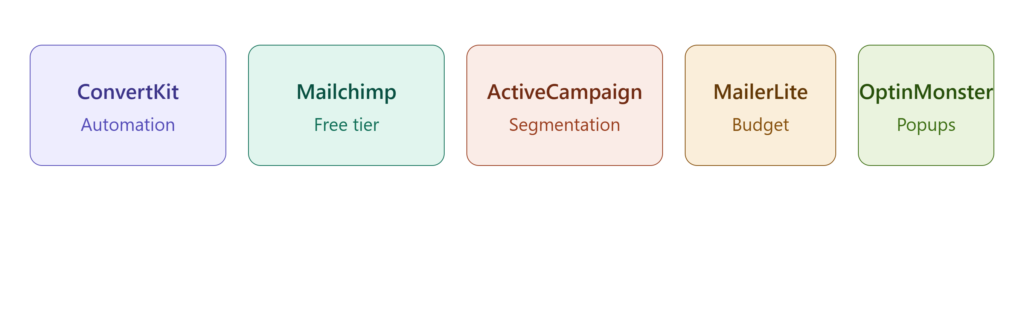
- ConvertKit – Popular among creators and affiliate marketers for its simple automation and creator-focused features.
- Mailchimp – Broad feature set with a free tier suitable for smaller, newer lists.
- ActiveCampaign – Advanced automation and segmentation capabilities suited to more established lists.
- MailerLite – Budget-friendly option with solid core email and automation features.
- OptinMonster or Sumo – Popup and signup form tools for maximizing on-site conversion without needing custom development.
Frequently Asked Questions (FAQ)
1. How big does my email list need to be before it’s worth the effort?
Even a small list of a few hundred engaged subscribers can generate meaningful income, especially with a well-optimized welcome sequence — the effort is worth starting long before your list reaches a large size.
2. Is it okay to include affiliate links in every email?
No — a healthy mix of genuinely valuable, non-promotional content alongside occasional affiliate promotions tends to maintain trust and engagement far better than a purely promotional cadence.
3. How often should I email my affiliate list?
A weekly or biweekly cadence works well for most affiliate niches, with consistency mattering more than the exact frequency chosen.
4. What’s the difference between a campaign and an automated flow?
Campaigns are one-time sends to your list, while automated flows (like a welcome sequence) trigger automatically based on subscriber actions — current data shows automated flows generating dramatically more revenue per email sent than standard campaigns.
5. Do I need a paid email platform to get started?
No, most major platforms offer free tiers for smaller lists, making it accessible to start building a list well before your site generates significant traffic or income.
6. How do I grow my list without a large existing audience?
Strategic lead magnets combined with well-placed signup forms across your existing content can grow a list steadily even without a large following, since this approach relies on capturing already-interested website visitors rather than requiring outside audience reach.
7. Should I segment my list even if it’s small?
Yes — even basic segmentation by interest or lead magnet source can meaningfully improve relevance and conversion, and starting the habit early makes it easier to maintain as your list grows larger.
8. What should I do with subscribers who never open my emails?
Run a re-engagement sequence targeting those inactive for 60-90 days, and remove those who still don’t respond — a smaller, engaged list protects deliverability and typically outperforms a larger, unresponsive one in actual conversions.
9. Can email marketing work well alongside SEO and social media?
Yes, and it works best when treated as the connective layer between your other channels — using search and social traffic to grow your list, and using your list to boost new content and extend your reach beyond any single platform’s algorithm.
Key Takeaways Before You Start
- Email remains one of the highest-ROI channels available, with affiliates using it earning meaningfully more on average than those who don’t.
- Automated welcome sequences dramatically outperform one-off manual campaigns, and deserve priority attention when your time is limited.
- A specific, narrowly-focused lead magnet consistently converts better than a vague, broad one.
- Segmentation and consistent sending cadence both meaningfully improve engagement and revenue over time, even on smaller lists.
- List building compounds slowly at first, much like SEO — patience through the early months pays off as traffic and subscriber count both grow together.
Conclusion
Email marketing remains one of the highest-converting, most reliable channels available to affiliate marketers — not despite being “old,” but because it offers something search and social traffic simply can’t: direct, repeated, algorithm-free access to an audience that has already opted in to hear from you. Combined with the niche selection, traffic diversification, program selection, and SEO strategies covered in earlier guides, a well-built email list rounds out a genuinely complete affiliate marketing foundation.
Start small if you need to — a single lead magnet and a basic welcome sequence is enough to begin — and build from there. As the income data in our previous guide showed, consistency compounds, and email is one of the channels most directly responsible for that compounding effect over time. Treat your list not as a side project, but as one of the core, owned assets your entire affiliate strategy is built around.
Ready to start building your list? Explore more in-depth guides at [ezmakaffiliates.com].
Curious about how much affiliate marketers really earn? Discover the realistic income ranges, key factors that affect earnings, and what you can expect as a beginner in 2026. https://ezmakaffiliates.com/how-much-do-affiliate-marketers-really-make/
Don’t miss our newest affiliate marketing tips, SEO guides, and online income strategies. Subscribe to our newsletter and get notified whenever we publish a new article.


One Response