


Affiliate Marketers It’s one of the most-searched questions in the entire industry, and for good reason — the honest answer spans an enormous range, from $0 to well over a million dollars a year. That range isn’t a marketing exaggeration; it reflects a genuinely uneven industry where a small percentage of affiliates capture the vast majority of total earnings, while a much larger group earns modestly or not at all.
In this guide, we’ll break down realistic affiliate marketing income using current 2026 industry data — by experience level, by niche, by traffic source, and by the habits that separate consistent earners from those who quit within the first few months. Rather than vague promises or unrealistic screenshots, this is meant to give you an honest, grounded picture of what’s actually achievable, and what it typically takes to get there.
New to affiliate marketing? Start with our beginner-friendly guide and learn the exact steps to build your first affiliate income online. https://ezmakaffiliates.com/affiliate-marketing-for-beginners-how-to-start/
Why Affiliate Income Varies So Much
Before looking at specific numbers, it helps to understand why affiliate marketing income is so unevenly distributed compared to a typical salaried job. Several factors compound together to create this spread:
- Time invested. Someone publishing consistently for two years has a fundamentally different content and traffic base than someone who started three months ago, and SEO-driven income compounds heavily over time rather than growing in a straight line.
- Niche selection. As covered in earlier guides, some niches simply pay significantly more per conversion or offer stronger recurring commissions than others, directly shaping the earning ceiling of otherwise similar effort.
- Traffic source and volume. Affiliates relying on a single, inconsistent traffic source generally earn far less than those with diversified, compounding traffic from SEO, email, and other channels working together.
- Consistency. A large share of people who try affiliate marketing publish a handful of posts, don’t see immediate results, and quit — which skews the overall averages downward and makes the gap between “tried it” and “stuck with it” enormous.
- Reinvestment and skill development. Affiliates who reinvest early earnings into better tools, content, or paid testing, and who continuously refine their approach based on data, tend to compound their results faster than those who treat it as a purely passive, set-and-forget effort.
Because of these compounding factors, industry-wide averages can be genuinely misleading if taken at face value — which is exactly why this guide breaks income down by specific, more meaningful categories instead.
Want to choose a profitable niche? Read our complete guide before you start building your affiliate website. https://ezmakaffiliates.com/how-to-choose-a-profitable-affiliate-marketing-niche/
The Big Picture: Industry-Wide Income Data for 2026
Current industry data paints a picture of a large, growing, but highly concentrated market. The global affiliate marketing industry is valued at somewhere between $17 billion and $20 billion in 2026, with projections pointing toward $27 billion to $31.7 billion within the next several years, reflecting continued, strong growth in the space overall.
Despite that growth, earnings remain heavily concentrated: roughly 10% of affiliates capture close to 90% of total industry revenue. On the individual level, surveys suggest around 41% of affiliate marketers earn less than $1,000 per month, while roughly 9% earn over $50,000 per month — an enormous spread that reflects just how differently this industry rewards experience, strategy, and consistency.
The commonly cited “average” affiliate income of around $8,000 per month is technically accurate but statistically misleading, since it’s pulled sharply upward by a small number of very high earners. The median — a more representative middle point — sits meaningfully lower, generally estimated between $3,000 and $4,000 per month among more established affiliates, or roughly $35,000 to $40,000 annually. Separately, around 57% of affiliates earn under $10,000 per year in total, while about 11% cross the $100,000 annual mark — reinforcing just how top-heavy this income distribution really is.

Income Breakdown by Experience Level
Perhaps the clearest way to understand realistic affiliate income is by stage of experience, since time invested tends to correlate strongly with earnings in this industry.
Beginners (0–6 Months)
Most beginners earn very little in their first six months — often $0 to a few hundred dollars per month — since this period is typically spent building content, learning the basics, and waiting for early SEO traction to develop. This is completely normal and doesn’t reflect a failed strategy; it reflects the natural lag between publishing and search visibility.
Intermediate Affiliates (6 Months – 2 Years)
Once affiliates reach the six-month mark and continue publishing consistently, income tends to jump meaningfully — among creators who maintain consistent output through this period, median monthly income has been reported to rise into the range of roughly $1,800 per month, with continued growth as content accumulates and begins ranking more broadly.
Established Affiliates (2–5 Years)
By this stage, affiliates with a solid, diversified content base and multiple income-generating traffic sources commonly earn in the range of $1,000 to $10,000 per month, with the exact figure heavily dependent on niche, program selection, and how well they’ve diversified beyond a single traffic channel.
Advanced / “Super Affiliates” (5+ Years, Highly Optimized)
The small percentage of affiliates who reach genuinely high income levels — sometimes tens of thousands of dollars per month or more — typically share several traits: deep niche specialization, multiple compounding traffic sources, sophisticated tracking and testing practices, and often a team supporting content production and site maintenance at scale.

Two Realistic Income Scenarios
To make these stages more concrete, here are two hypothetical but realistic scenarios illustrating how income commonly develops in practice.
Scenario A: The Consistent Part-Timer Someone publishes one article per week alongside a full-time job, staying consistent for two full years. Early months produce little to no income, but by month eight, a handful of articles begin ranking for long-tail keywords, generating a first small trickle of commissions. By the end of year one, monthly income reaches roughly $300–$600. By the end of year two, with a larger content library and an email list started around month ten, income has grown to somewhere in the $1,500–$3,000 per month range — meaningful supplementary income, though not yet a full-time replacement.
Scenario B: The Focused Full-Timer Someone dedicates full-time hours to a single, well-researched niche from day one, publishing several pieces per week, building an email list early, and diversifying traffic across SEO, Pinterest, and YouTube within the first six months. Early months still produce minimal income, reflecting the unavoidable SEO lag discussed earlier — but by month twelve, with significantly more published content and multiple compounding traffic sources, income has grown to roughly $3,000–$6,000 per month. By year two, with continued consistency and program diversification, this scenario often reaches $8,000–$15,000 per month, approaching or exceeding full-time income replacement.
Neither scenario is guaranteed, and actual results depend heavily on niche, execution quality, and market conditions — but both illustrate the same core pattern: minimal early income followed by accelerating growth as content and traffic compound, with the pace of that growth largely determined by time invested and strategic diversification.
Income Breakdown by Niche
As covered in an earlier guide on niche selection, the niche you choose has a direct, measurable impact on your income ceiling. Current data shows clear differences across categories:
- Education and e-learning affiliates report some of the highest average monthly incomes of any niche, with figures around $15,500 per month among tracked affiliates, driven by high-ticket courses and certifications.
- Travel affiliates report strong average monthly incomes as well, commonly cited around $13,800 per month, reflecting high-value bookings and strong seasonal demand.
- Software and SaaS affiliates report solid, more moderate average monthly incomes, commonly cited around $6,000 per month, often boosted by recurring commission structures that compound over time.
- Parenting, family, and general personal development niches report meaningfully lower average incomes, sometimes as low as $1,100 to $1,200 per month, reflecting lower-ticket products and more saturated, lower-intent content spaces.
These figures represent averages within each niche, not guarantees — a well-executed strategy in a lower-paying niche can still outperform a poorly executed one in a higher-paying niche. But all else being equal, niche selection genuinely does shift the realistic income ceiling available to you.
Want more visitors and clicks on your affiliate content? Check out our proven traffic-generation strategies to grow your audience and increase conversions. https://ezmakaffiliates.com/how-to-drive-traffic-to-your-affiliate-links/
Income Breakdown by Traffic Source
Where your traffic comes from also meaningfully shapes both your income level and its stability over time, as covered in more depth in our traffic strategy guide.
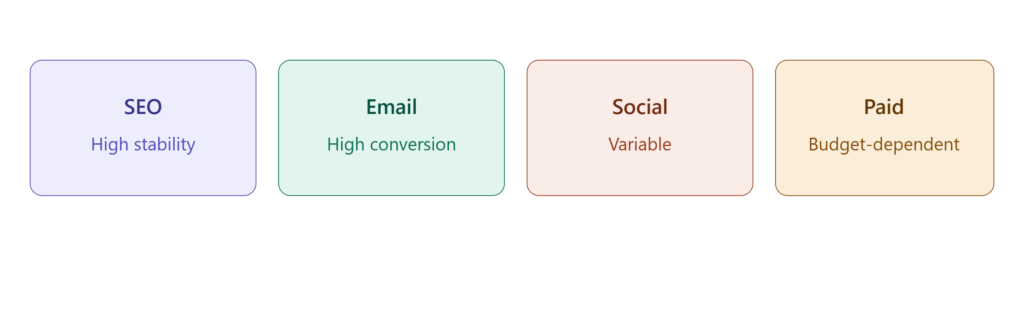
Organic search currently drives over half of all affiliate traffic industry-wide, and SEO-driven affiliates tend to report more stable, compounding income over time compared to those relying primarily on social media, where reach can fluctuate significantly month to month based on algorithm changes. Email marketing, while typically a smaller share of total traffic, tends to convert at a notably higher rate due to the pre-qualified, opted-in nature of subscribers, often supporting outsized income relative to its traffic volume. Paid traffic can produce fast income but requires ongoing budget and careful management to remain profitable, making it a less stable long-term foundation on its own compared to organic, compounding channels.
Affiliates relying on a single traffic source — regardless of which one — tend to report more volatile, less predictable income than those who’ve diversified across two or three complementary channels, reinforcing the diversification principle covered throughout this content series.
Seasonal Income Patterns Affiliates Should Expect
Affiliate income rarely arrives evenly across the year — most niches experience meaningful seasonal swings that are worth planning around rather than being surprised by. The fourth quarter, spanning October through December, commonly generates 30% to 50% of many affiliates’ total annual income, driven by Black Friday, Cyber Monday, and broader holiday shopping demand across nearly every consumer-facing niche.
Beyond the holiday season, individual niches carry their own seasonal patterns — travel affiliates often see stronger demand around major booking windows earlier in the year, fitness and health niches frequently spike around January’s New Year resolution period, and back-to-school timing can meaningfully boost education and productivity-related niches in late summer.
Understanding your own niche’s seasonal rhythm matters for two practical reasons: it helps you avoid mistaking a normal seasonal dip for a failing strategy, and it lets you plan content and promotional pushes — like updating “best gift” or “best deals” content ahead of Q4 — to align with when buyer intent is naturally at its highest.
Metrics That Actually Predict Income Growth
Beyond overall monthly earnings, a handful of specific metrics tend to predict future income growth more reliably than total traffic alone, and tracking them consistently is a habit shared by most high-earning affiliates.
- Click-through rate (CTR): The percentage of readers who actually click your affiliate links. A low CTR despite solid traffic often signals a content or link-placement problem worth addressing before chasing more visitors.
- Conversion rate: The percentage of clicks that result in an actual purchase. This reflects both the quality of your traffic and how well-matched your recommendations are to what readers are actually looking for.
- Earnings per click (EPC): Often considered the single most useful metric, since it combines commission value and conversion rate into one number, letting you directly compare the real earning potential of different programs or content pieces.
- Average order value (AOV): Higher AOV products can produce strong income even with modest conversion rates, which is part of why niche and program selection, covered in earlier guides, matters so much to overall earning potential.
Affiliates who track these metrics consistently can identify which specific content, programs, and traffic sources are actually driving income — and which are quietly underperforming despite looking fine on the surface — allowing them to reallocate effort toward what’s genuinely working rather than spreading it evenly across everything.
What Realistic Income Actually Looks Like at Different Levels
To make these numbers more concrete, here’s what different income tiers commonly correspond to in practice:
$0–$500/month: Typically a newer site still building content and waiting for initial SEO traction, or a hobbyist posting inconsistently without a dedicated content or traffic strategy.
$500–$2,000/month: Often a site with 6–18 months of consistent publishing, some ranking content, and at least one reasonably reliable traffic source, generating steady but modest income.
$2,000–$10,000/month: Commonly reflects a more mature site with a larger content library, multiple traffic sources, a diversified affiliate program portfolio, and often some degree of email list monetization supporting overall income.
$10,000+/month: Usually reflects either a well-established site with years of compounding SEO authority, a highly specialized high-ticket niche, or a small team supporting a larger content and traffic operation rather than a single person working alone.
It’s worth noting that a separate category — salaried “affiliate marketing manager” or “affiliate marketing specialist” roles at companies, as opposed to independent affiliates earning commissions — report an average annual salary in the range of $80,000 in the United States as of 2026. This is a genuinely different career path from independent affiliate marketing and shouldn’t be confused with typical commission-based affiliate income, though it’s a relevant option worth knowing about for people with strong marketing skills who prefer employment stability over independent, commission-based income.
How Long It Takes to Reach Different Income Milestones
Setting realistic timeline expectations is one of the most important parts of approaching affiliate marketing sustainably, since mismatched expectations are a major reason people quit prematurely.
Months 1–6: Typically $0 to a few hundred dollars per month, focused primarily on content creation and early SEO foundation-building rather than income generation itself.
Months 6–12: Income commonly begins climbing meaningfully for affiliates who’ve published consistently, often reaching several hundred to low four figures per month as early content begins ranking and traffic compounds.
Year 2: With a larger content library, improving search rankings, and often an expanding email list, many consistent affiliates reach the $1,000–$5,000 per month range during this period.
Year 3+: Affiliates who’ve maintained consistency, diversified traffic and programs, and continuously refined their approach based on data commonly move into the $5,000–$10,000+ per month range, with the small minority reaching well beyond that as genuine “super affiliates.”
It’s worth explicitly noting: comparing your first-month earnings to a three-year affiliate’s current income is comparing two fundamentally different stages of a compounding process, not a fair measure of whether your specific strategy is working.

What Separates High Earners from Everyone Else
Given how concentrated affiliate income is, it’s worth examining what genuinely distinguishes the top-earning minority from the much larger group earning modestly or nothing at all.
- They treat it as a real business, not a side experiment. High earners invest real time and often real money into content, tools, and testing, rather than publishing a handful of posts and waiting passively for results.
- They diversify across multiple traffic sources. As covered above, relying on a single channel correlates strongly with unstable, lower income compared to a diversified traffic strategy spanning SEO, email, and at least one social or video channel.
- They track data and make decisions based on it. Metrics like click-through rate, conversion rate, and earnings per click let high earners identify and double down on what’s actually working, rather than guessing.
- They specialize deeply rather than spreading thin. A tightly focused niche, covered comprehensively, consistently outperforms a broad, shallow approach spread across too many unrelated topics.
- They stick with it well past the point most people quit. Given that meaningful income typically takes 12+ months to develop, sheer persistence through the slow early period is itself a major differentiator between eventual high earners and those who give up in month three or four.
- They stay current with SEO and platform changes. As covered in our SEO guide, the search landscape — including the rise of AI-powered search — continues evolving, and affiliates who adapt their strategy accordingly tend to maintain stronger long-term results than those relying on outdated tactics.
Looking for the best affiliate programs to maximize your earnings? Explore our top picks for beginners and experienced marketers alike. https://ezmakaffiliates.com/best-affiliate-marketing-programs-to-join/
How Reinvestment Accelerates Income Growth
One pattern that consistently shows up among higher-earning affiliates is a willingness to reinvest early income back into the business rather than treating every dollar earned as pure profit to withdraw immediately. This reinvestment typically follows a fairly predictable progression as a site grows.
In the earliest stage, reinvestment might mean simply covering basic hosting and a domain — modest costs that keep the foundation running. As initial income arrives, many affiliates reinvest in a proper keyword research tool or SEO software, which helps identify better content opportunities and track progress more precisely than guessing. Further along, some reinvest in outsourced writing or design help, allowing them to publish more consistently than they could manage alone, particularly if they’re balancing affiliate marketing alongside other work.
At more established stages, reinvestment might extend to paid traffic testing, more advanced analytics tools, or even hiring part-time help for tasks like link building outreach or content updates. This compounding reinvestment cycle — where early modest earnings fund tools and help that accelerate further growth — is a meaningful part of why income among established affiliates tends to accelerate rather than grow at a flat, linear rate over time.
Affiliates who instead withdraw all early income as personal spending money, without reinvesting any of it back into growth, commonly report slower overall progress compared to those who treat at least a portion of early earnings as working capital for the business.
Common Income Myths and Misconceptions
- “Affiliate marketing is passive income from day one.” In reality, early months require substantial active effort in content creation and traffic building before any meaningful passivity develops later on.
- “The average income figure tells you what to expect.” As covered above, average figures are skewed heavily upward by a small number of top earners; the median is a far more realistic benchmark for most people.
- “You need a huge following to earn real money.” Many successful affiliates build income primarily through SEO and email, neither of which requires a large social media following to work effectively.
- “If it’s not working in month one, it’s not working.” Given typical timelines, judging affiliate marketing’s viability within the first few months rarely reflects its eventual, longer-term potential.
- “Higher commission percentages always mean higher income.” As covered in earlier guides, conversion rate and average order value matter just as much as commission percentage, if not more.
- “Once you’re earning, the work is done.” Sustained income typically requires ongoing content updates, continued publishing, and adaptation to platform and algorithm changes rather than a true “set it and forget it” outcome.
- “Everyone who tries affiliate marketing eventually succeeds if they just keep going.” Persistence matters enormously, but it needs to be paired with sound strategy, niche selection, and diversification — persistence alone, applied to a fundamentally flawed approach, doesn’t reliably produce results.

Don’t Forget Costs and Taxes When Evaluating Real Income
Gross affiliate commissions are not the same as actual take-home income, and beginners sometimes overlook this when comparing their results to figures they see quoted elsewhere. Running a genuine affiliate site typically involves ongoing costs — hosting, a keyword research or SEO tool subscription, email marketing software, and occasionally paid design or writing help as the site scales.
In most countries, affiliate income is also taxable as either self-employment or business income, meaning a meaningful percentage of gross commissions should be set aside for tax obligations rather than treated as fully available spending money. Keeping basic records of both income and business expenses from the very beginning — even before earnings become substantial — makes this significantly easier to manage once income grows, and many routine business expenses may be deductible depending on your local tax rules.
None of this is meant to discourage pursuing affiliate marketing — rather, it’s meant to help you evaluate quoted income figures more realistically, since a site earning $5,000 per month in gross commissions, after tools, taxes, and any outsourced help, may net meaningfully less than that headline number suggests.
How Affiliate Income Compares to Other Side Income Streams
It’s worth briefly situating affiliate marketing income against other common ways people build supplementary or independent income, since the comparison highlights both its advantages and its trade-offs.
Compared to freelancing or gig work, affiliate marketing generally takes longer to produce initial income, since freelance work typically gets paid immediately upon completing a task, while affiliate content needs time to attract traffic and build trust before converting. However, affiliate income has a genuine advantage in scalability — a single well-ranking article can keep earning indefinitely without additional hours invested, whereas freelance income is generally capped by the hours you personally work.
Compared to starting an e-commerce store, affiliate marketing typically requires far less upfront capital, since there’s no inventory, shipping, or customer service overhead to manage. The trade-off is a lower typical profit margin per sale, since affiliate commissions represent only a percentage of a sale rather than full product markup.
Compared to a salaried marketing role — like the affiliate marketing manager positions mentioned earlier — independent affiliate income offers no guaranteed floor and a longer initial ramp-up period, but it offers essentially uncapped upside and full independence, without needing an employer’s approval to scale efforts up.
None of these comparisons make affiliate marketing objectively “better” or “worse” than the alternatives — they simply highlight that its particular combination of low upfront cost, slow initial ramp-up, and strong long-term scalability makes it a genuinely different kind of income stream, best suited to people willing to trade faster initial income for a compounding, longer-term payoff.
Frequently Asked Questions (FAQ)
How much do beginner affiliate marketers make in their first month?
Most beginners earn $0 to a very modest amount in their first month, since this period is typically focused on building content and waiting for initial search visibility rather than generating significant income yet.
What’s a realistic income goal for year one?
Reaching a few hundred to low four figures per month by the end of year one is a realistic, achievable target for consistent affiliates, though results vary significantly by niche and effort level.
Is the commonly cited “$8,000 average” realistic to expect?
Not for most people. That figure is heavily skewed by a small number of very high earners; the median income across the industry is meaningfully lower, generally in the range of a few thousand dollars per month among more established affiliates.
Which niche pays the most for affiliate marketers?
Education and e-learning, along with travel, currently report some of the highest average monthly incomes, though niche selection should also account for your own interest and the sustainability factors covered in our niche selection guide.
Do I need a large audience to earn significant affiliate income?
No. Many affiliates earn substantial income primarily through SEO-driven organic search traffic and email marketing, neither of which depends on having a large social media following.
How long before affiliate marketing becomes a full-time income replacement?
This varies widely, but reaching a genuinely full-time-replacement income level commonly takes two to three years or more of consistent, strategic effort for most successful affiliates.
Why do most people who try affiliate marketing earn very little?
Primarily due to inconsistency — publishing a handful of posts and quitting before SEO and audience-building have had time to compound — combined with relying on a single traffic source and lacking a clear tracking or optimization strategy.
Should I quit my job to pursue affiliate marketing full-time?
Given the typical 12-24 month timeline to reach substantial income, most successful affiliates recommend building a site alongside existing income first, only transitioning to full-time once monthly earnings have demonstrated consistent, reliable growth over several months.
Do successful affiliates ever stop earning after building a site?
Income can decline without ongoing maintenance — search algorithms change, competitors publish new content, and products get discontinued — so even established affiliates typically need to continue updating content and adapting their strategy to sustain, not just reach, meaningful income levels.
Key Takeaways Before You Set Your Own Income Goals
- Industry averages are heavily skewed by a small number of top earners — the median income is a far more realistic benchmark for planning purposes.
- Most beginners earn little to nothing in their first six months, and this is a normal, expected part of the process rather than a sign of failure.
- Niche, traffic diversification, and consistency are the three factors most strongly correlated with reaching higher income tiers over time.
- Meaningful, life-changing income typically takes 12 to 24 months or longer of consistent, strategic effort — rarely less.
- Gross commissions are not the same as net income once tools, taxes, and reinvestment are factored in.
Conclusion
Affiliate marketing income spans an enormous range — from $0 to well over a million dollars annually — and that range reflects real, measurable differences in experience, niche, traffic strategy, and above all, consistency. The commonly cited industry “average” is technically true but statistically misleading; a more honest benchmark is the median, along with an understanding of how income typically develops over the first several years for affiliates who stick with it.
If you’re just starting out, use this data to set realistic expectations rather than either unrealistic hype or premature discouragement. Progress in this industry rarely looks like a straight line — it looks like a long, flat stretch of minimal returns, followed by a gradually steepening curve as content, traffic, and trust all compound together. The affiliates who reach meaningful income are, almost without exception, simply the ones who kept showing up through that flat stretch long enough for the curve to bend upward.
Combine sound niche selection, diversified traffic, a well-chosen program portfolio, and solid SEO fundamentals — all covered in earlier guides in this series — and give the compounding process the time it genuinely needs to work.
Ready to build your own affiliate income strategy? Explore more in-depth guides at [ezmakaffiliates.com].
Want to rank your affiliate content higher on Google? Learn the latest affiliate SEO strategies to boost rankings, increase traffic, and grow your commissions. https://ezmakaffiliates.com/affiliate-marketing-seo-how-to-rank-google/
Don’t miss our newest affiliate marketing tips, SEO guides, and online income strategies. Subscribe to our newsletter and get notified whenever we publish a new article.



One Response